
How to Tell If an AI Tool Is Worth Paying For

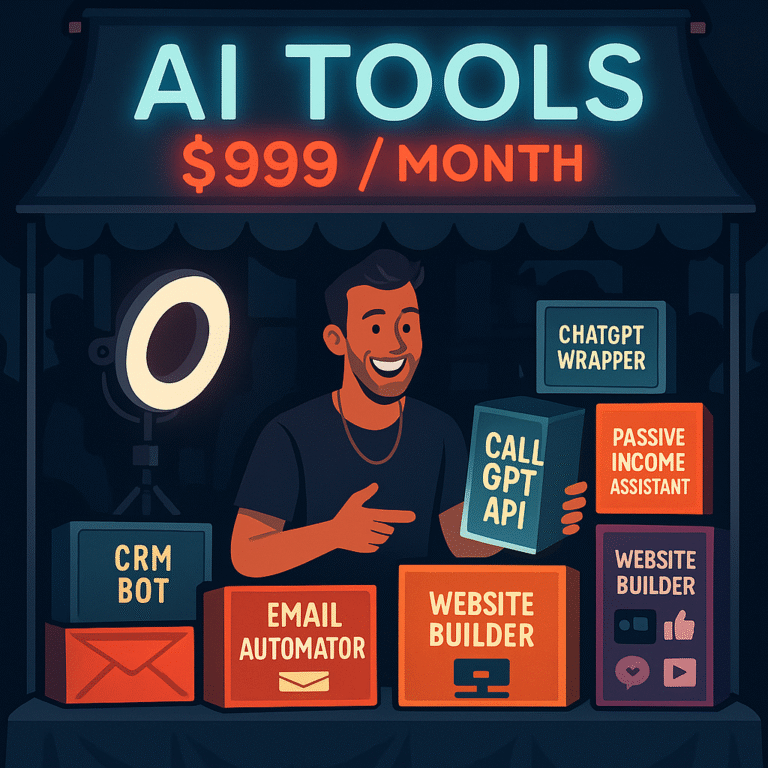
Don’t fall for the $999 AI tools being pushed by Instagram bros and TikTok grifters: If it’s just a glorified ChatGPT call in a shiny box, you’re being upsold on laziness. Real value comes from integration, automation at scale, and actual technical depth. Not viral bullshit.

(Hint: If You Found It on TikTok, It Probably Isn’t.)

There’s an entire sub-economy forming on TikTok and Instagram, built around selling $999/month “AI tools” that are nothing more than glorified Make.com flows with a GPT API call glued on. A bit of webhook sugar, a splash of Canva branding, and suddenly it’s being marketed as “enterprise AI automation for busy professionals.” Spoiler: it’s not. It’s usually something a half-decent dev could build in two hours for free, and it’s being peddled to people who don’t know better.

If you’re about to swipe your card for one of these, slow down. Let’s break it down.

Here’s how to spot a tool that’s all sizzle, no steak. If it just sends your text to ChatGPT and spits back an answer with slightly nicer formatting, that’s not a product. It’s a prompt. If it’s clearly built on Zapier or Make, and the workflow is “new email → call GPT → send response,” you’re paying a monthly fee to avoid dragging boxes in a UI. If the tool has no real logic – no dynamic context, no chaining, no validation, no fallback handling – then it’s just a wrapper, and you’re the sucker.

And if all the “testimonials” are from influencers with identical thumbnails and generic claims like “this tool changed my business,” walk away. You’re being sold on lifestyle, not functionality.

Now, what’s actually worth paying for?

If the tool saves you hours at real scale (hundreds of actions per day), sure. If it integrates tightly with your internal systems – not just Google Sheets and Notion, but your CRM, billing, inventory, whatever – then you’re buying infrastructure, not convenience. If it handles errors, supports multi-step chaining, or works in real-time with structured output? That’s leverage, not fluff. And if it lets your team do complex things without needing to know how to build prompts or manage APIs, then it’s adding real value.

Here’s the acid test. Ask yourself:

  1. Could I rebuild 80% of this in Make, n8n, or Google Sheets?
  2. Is the “AI” doing anything besides rewriting text?
  3. Would I even look at this tool twice if it didn’t say “powered by GPT”?

If the answer to any of those is “yes,” then you’re not buying tech. You’re paying for someone’s rent while they film content about how they “automated a car dealership and now make $40K/month in passive income.”

The AI hype machine is full of wrappers. You don’t need wrappers. You need results.

Spend your money like someone who understands how tools work. Not like someone hypnotized by a 30-second Reel with a Lambo in the background.
Christian Holmgreen is the Founder of Epium and holds a Master’s in Computer Science with a focus on AI.

AI Grifters

Recursive Self-Improvement Has a Verifier Problem

Recursive self-improvement sounds simple: an AGI makes itself smarter, then repeats the process faster. But “better” is not a single measurable quantity. A new system can improve reasoning while regressing in coding, instruction-following or reliability.

That creates a verifier problem. If the system grades its own successor, it may only confirm improvements against the rubric it already chose. Without external tasks, real-world feedback and regression testing, recursive self-improvement risks becoming recursive self-approval rather than genuine progress toward ASI.

Scaffolding Might Get Us to AGI. ASI Is a Whole Other Ballgame

AGI may emerge from scaffolding around LLMs – memory, tools, specialist models, executive control and persistent state – rather than from one giant model becoming “intelligent.”

ASI is different. An AGI can generate better architectures and run more experiments, but research success is not automatic. Training still costs time, compute and power, and most ideas may fail.

Scaffolding may get us to AGI. It does not automatically get us to ASI.

Beyond Context Windows: A Simple Idea for Real AI Memory

AI assistants are getting bigger context windows, but they still forget everything that matters. This article lays out a practical idea for fixing that: a three-layer memory system – short-term, mid-term, long-term – that lets an assistant keep continuity over days, weeks, and projects without drowning in raw transcripts. It’s not a grand theory or a product spec, just a blueprint for how AI could move from a clever tool to a real long-term collaborator.

Agentic AI Explained

Agentic AI marks a practical step forward in automation – not a leap toward artificial general intelligence. It connects goals, memory, and tools around a simple loop of observe, decide, act, evaluate, repeat. This article explains how these systems actually work, what they can automate effectively, and why their real power lies in dependable execution rather than self-awareness.

Practical AI for Amazon Listings (2025): Writing for COSMO, Not Keywords

AI isn’t magic – it’s an assistant. And like any assistant, it only delivers quality when you give it clear instructions. This guide shows how to use AI for something concrete: writing and optimizing Amazon listings in 2025. You’ll see exactly how to brief an AI so it produces usable, compliant copy that aligns with Amazon’s COSMO algorithm – instead of keyword-stuffed nonsense. If you want to understand how prompt engineering translates into real business outcomes, this is it.