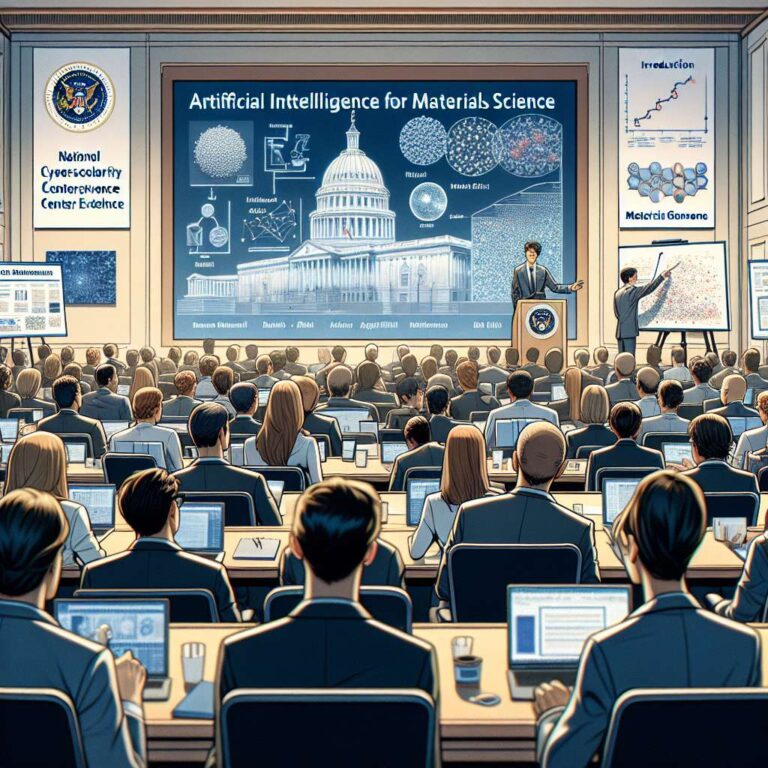
The National Institute of Standards and Technology (NIST) has announced the 6th Artificial Intelligence for Materials Science (AIMS) workshop, set to take place in person on July 9–10, 2025, at the National Cybersecurity Center of Excellence in Rockville, Maryland. This latest installment in the JARVIS workshop series aims to advance the integration of Artificial Intelligence with the Materials Genome Initiative (MGI), focusing on expediting materials discovery and innovation via high-throughput computation and experimentation. Attendees are encouraged to submit poster abstracts by June 27, 2025, with a best poster competition open to early career researchers.
The workshop will address a breadth of technical challenges and emerging topics at the intersection of Artificial Intelligence and materials science, especially for inorganic solid-state materials. Key themes include curating and diversifying datasets, devising material representations, inverse design, autonomous laboratories, merging physics-based and Artificial Intelligence models, uncertainty quantification, and building robust infrastructures for sharing Artificial Intelligence knowledge. The program will showcase recent advances in machine learning force fields, graph neural networks, generative and foundation models, large language models, as well as methods for integrating experimental data with Artificial Intelligence approaches.
Featured speakers represent leading universities, major tech companies, and national laboratories, including experts from MIT, Meta, Carnegie Mellon University, Samsung, Columbia, Princeton, University of Maryland, and NIST itself. The agenda encompasses talks on topics such as real-time Artificial Intelligence-driven optimization of laboratory experiments, machine learning for device-scale modeling, generative modeling for material stability, and autonomous, large language model-guided experimentation. Hands-on training and collaborative sessions are incorporated, providing participants with practical insight into applying state-of-the-art Artificial Intelligence methods to materials research. The event provides a vital forum for cross-disciplinary dialogue, catalyzing progress in both the modeling and experimental dimensions of materials discovery.