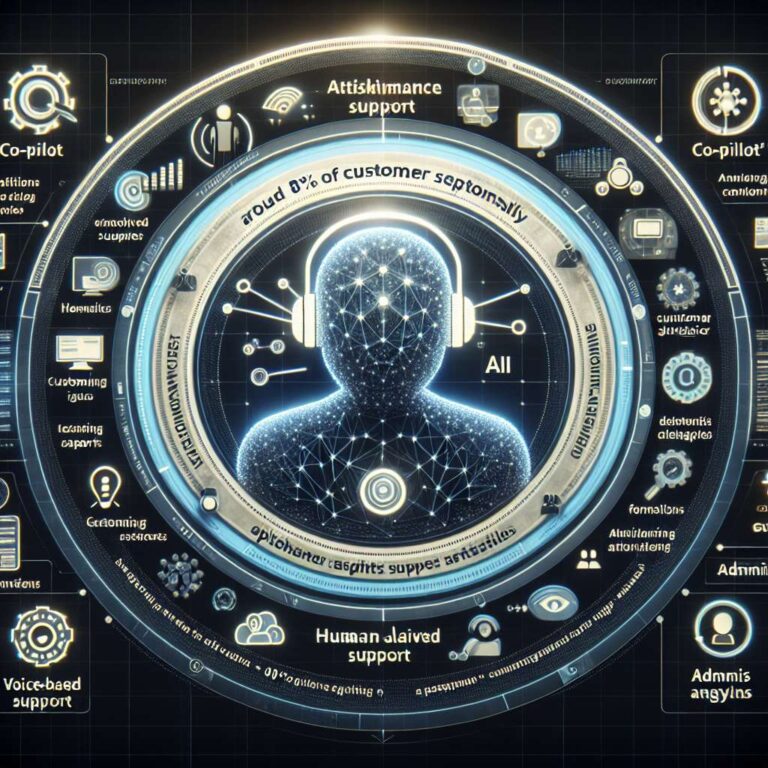
Zendesk announced a wave of large language model driven products at its Artificial Intelligence summit, headlined by an autonomous support agent the company says can resolve 80 percent of customer issues without human intervention. The rollout also includes a co-pilot to assist human agents with the remaining 20 percent of harder cases, plus an admin layer agent, a voice-based agent and an analytics agent. The package aims to reduce reliance on human technicians while keeping humans in the loop for complex scenarios.
Shashi Upadhyay, Zendesk’s president of Product, Engineering and Artificial Intelligence, framed the launch as part of a broader industry shift toward systems where Artificial Intelligence handles most of the work. “The world’s going to shift from software that’s built for human users, to a system where Artificial Intelligence actually does most of the work,” he told TechCrunch. Independent benchmarks suggest the technology is progressing toward that goal. On TAU-bench, which tests a model’s tool calling skills on tasks like processing a return, the current leader Claude Sonnet 4.5 resolves 85 percent of issues, indicating strong performance on workflows analogous to customer support.
The analytics agent launching today is built on Zendesk’s Hyperarc acquisition completed in July, part of a dealmaking streak that followed a contentious investor fight in 2022. Earlier Artificial Intelligence acquisitions include the QA and agentic service system Klaus in February 2024 and automation platform Ultimate the following March. Zendesk has previewed the new stack with select customers, and Upadhyay says early results are encouraging, citing consumer satisfaction gains of five to 10 points.
Companies such as Airbnb and Regal Theaters have already experimented with chatbot-based support, typically focused on information retrieval. Zendesk’s push emphasizes more complex troubleshooting and self-directed action, which could have significant economic implications if it scales. The company’s Resolution Platform serves nearly 20,000 customers and resolves 4.6 billion tickets annually. More broadly, the United States alone employs 2.4 million customer service representatives, with larger workforces in other countries. If autonomous agents shoulder most routine support tasks, it could reshape contact center operations, redefine human roles toward exceptions and oversight, and raise expectations for measurable gains in satisfaction and resolution rates.