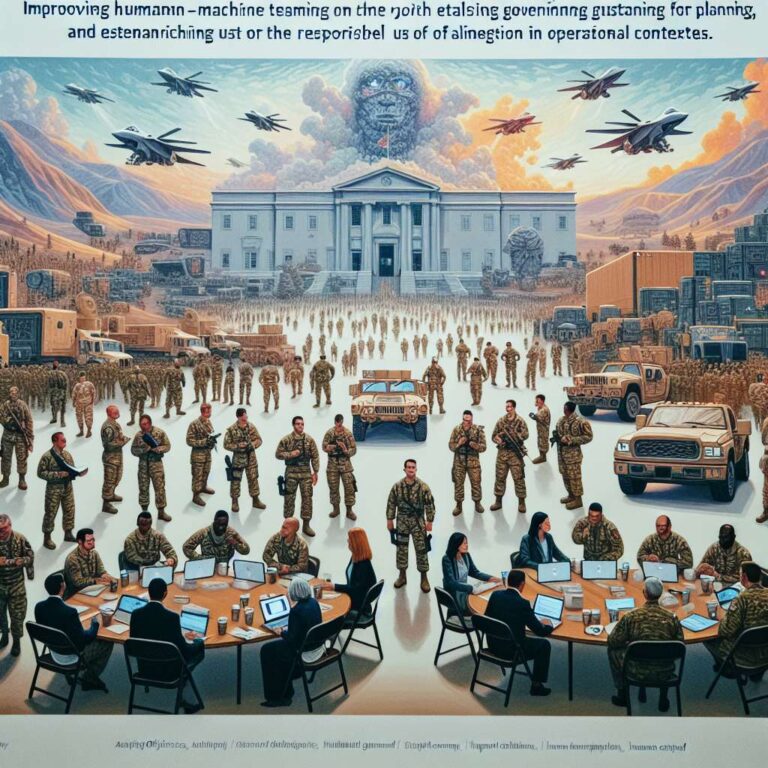
U.S. Space Command’s joint operations division hosted the first artificial intelligence enabled Augmented Planning and Execution summit from Nov. 18-21, 2025, at its Bayfield facility and at a MITRE Corporation site in Colorado Springs. The event was designed to accelerate warfighting readiness by using Artificial Intelligence tools to streamline complex planning and generate inputs for the 2026 Coordinated Campaign Order. More than 70 leaders attended, including seven division chiefs from U.S. Space Command and representatives from its component commands, reflecting a deliberate effort to create a more integrated and agile operational approach in a rapidly evolving and contested space domain.
The summit focused on two primary objectives: improving human and machine teaming for the USSPACECOM J35 integrated campaign order and establishing a governance model for the responsible use of Artificial Intelligence in operational planning, according to supervisory program analyst Genna Ibsen. Each joint directorate and component command received five campaign objectives and command guidance, and participants curated procedural documents, doctrine, references, and manuals so that Artificial Intelligence systems processed only the most relevant and accurate material. Staff then verified Artificial Intelligence generated outputs in a process described as “Artificial Intelligence generated, human curated,” ensuring that automation supported rather than replaced operational judgment.
Participants were organized into four teams and used three different Artificial Intelligence tools to evaluate planning processes. Teams worked with one tool on the first day and another on the second, rotating through structured campaign order prompting, self directed exploration, and engineer guided collaboration while leveraging a large language model to synthesize insights. This two day approach allowed teams to compare outcomes, refine directives, and focus on operationally relevant innovations. Each team worked through a distinct strategic lens, including U.S. Space Command as a supporting command, U.S. Space Command as a supported command, multinational Operation Olympic Defender collaboration, and a nexus of space, cyber, and special operations. Col. John Gibson said the supported command lens produced the most options for how the joint force could enable the command’s mission, and he noted that bringing components, staff, and Artificial Intelligence tools together in one room reshaped collaboration and understanding of operational challenges.
The summit followed U.S. Space Command’s adoption of its first Artificial Intelligence, machine learning, and data analytics strategy in March, which is being applied across mission areas such as integrated space fires, command and control, electronic warfare, battlespace awareness, space systems cyber defense, and logistics. Commander Gen. Stephen Whiting has framed the Artificial Intelligence strategy as essential for adapting to what he called an era defining technology with growing importance for national security. The APEX summit demonstrated how the command is leveraging Artificial Intelligence to support rapid senior level decision-making, with the 2026 Coordinated Campaign Order set to incorporate the best outputs produced. As U.S. Space Command synchronizes multidomain global operations with the joint force, allies, and partners, it plans to further refine and integrate Artificial Intelligence into its processes to improve decision-making, operational efficiency, and mission success.