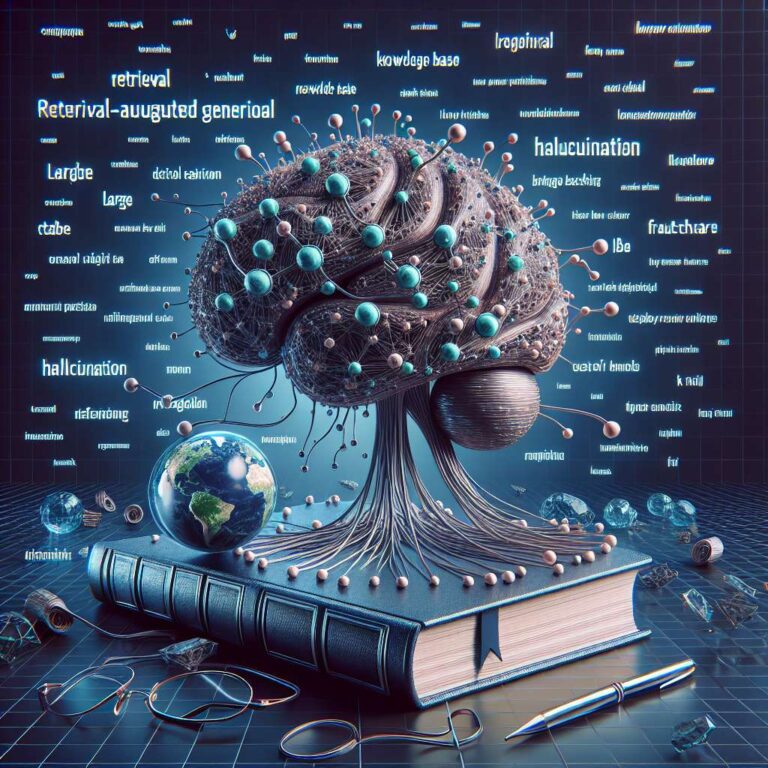
The article explains retrieval-augmented generation, or RAG, as a technique that addresses key weaknesses of large language models whose knowledge is frozen at training time and which can confidently invent facts, a behavior described as hallucination. RAG is framed as giving a model an open-book test, where instead of relying only on memorized knowledge, the model is allowed to look up current, relevant information from an external source before answering a question. It defines retrieval-augmented generation as an Artificial Intelligence framework that enhances a large language model’s response by first retrieving relevant data from an external knowledge source and providing it as context.
The process is described as having two main stages: retrieval and generation. In the retrieval step, when a user asks a question, the system does not immediately send the query to the large language model, but instead searches through a connected knowledge base and identifies the most relevant snippets of information related to the question. Next, it bundles the original question with the information it just found, and this combined package is then sent to the large language model, which uses the new, rich context to formulate a response in the augmented generation step. The final answer is grounded in the retrieved facts rather than just the model’s internal training data, effectively making the model more of a reasoner and communicator while the knowledge base acts as a fact-checker.
The article highlights several benefits of retrieval-augmented generation, starting with more trustworthy and accurate answers because responses are based on specific, verifiable information, which significantly reduces the chance of hallucination. It notes that this approach keeps a model’s knowledge current without constant, expensive retraining, since updating the external knowledge base instantly gives the model access to new information. A cited description states that “Retrieval-Augmented Generation (RAG) integrates external knowledge with Large Language Models (LLMs) to enhance factual correctness and mitigate hallucination.” The retrieval step also improves relevance by ensuring that the context provided to the model is highly specific to the user’s query, leading to more focused and useful answers, while the ability to cite sources provides transparency and allows users to check facts themselves. The piece concludes that, in essence, retrieval-augmented generation makes large language models more reliable by connecting them to the real world of facts and data.