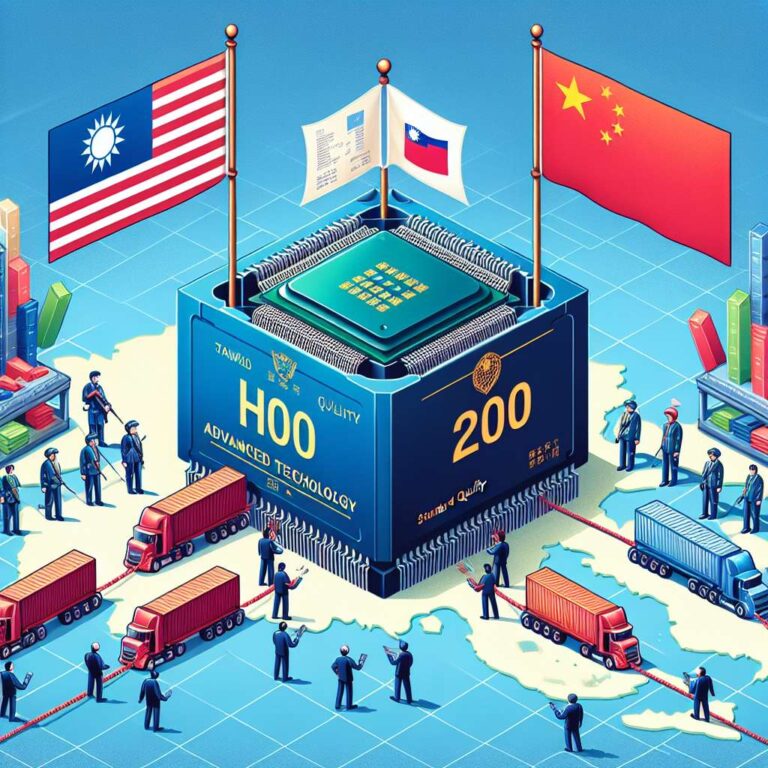
The Techmeme River snapshot for December 13 and December 12, 2025, highlights escalating geopolitical and commercial tensions around Artificial Intelligence chips, as President Trump reverses long standing U.S. tech restrictions by allowing Nvidia to sell its H200 chips to China while Beijing simultaneously moves to limit access and boost local alternatives. Bloomberg reports that President Trump’s decision to let Nvidia export H200s to China is framed as a lower security risk because Huawei already offers systems with comparable performance, and another Bloomberg item notes that some Biden era officials believe access to Nvidia chips could help China’s Artificial Intelligence companies buy time while Chinese chipmakers improve their supply and performance. At the same time, the Financial Times reports that Beijing is set to restrict access to Nvidia’s H200 chips despite Trump’s move, as part of a broader push for chip self sufficiency, and David Sanger writes that this export approval reverses decades of U.S. policy aimed at limiting access to cutting edge technology for adversaries, potentially giving China a boost in the Artificial Intelligence race.
The feed shows how these chip policy shifts intersect with market behavior and enforcement. Reuters reports that Nvidia’s H200 chips for China, mainly manufactured in Taiwan, will travel to the U.S. for an unusual national security review before export, and another Reuters story says Nvidia has privately demonstrated unreleased location verification technology that could show what country its chips are operating in. Bloomberg adds that Nvidia told Chinese clients it is considering adding production capacity for its H200 chips after orders exceeded its current output level, while other reports detail U.S. enforcement, such as the Department of Justice detaining two men accused of trying to smuggle $160M+ of Nvidia H100 and H200 chips to China, with a third man pleading guilty. In parallel, a New York Times piece says U.S. investors are boosting Chinese Artificial Intelligence related tech stocks and adding cash to exchange traded funds tracking China’s tech sector, even as lawmakers push for tighter capital controls.
The snapshot also documents China’s countermoves to reduce reliance on U.S. hardware. Financial Times reporting says China added Artificial Intelligence chips from domestic groups to its government approved list of suppliers for the first time before Trump’s export decision, and Bloomberg cites TechInsights in describing Huawei’s Kirin 9030, produced with SMIC’s updated 7nm technology, as China’s most advanced chip to date. Another Bloomberg item notes that some Chinese buyers, including in state backed sectors, are prioritizing semiconductor independence and subsidizing Huawei, and that China is considering a ~$28B-to-$70B incentives package, separate from the $50B Big Fund III plan, to support its chipmaking industry. Taken together, the articles present a picture of a rapidly evolving Artificial Intelligence hardware landscape in which U.S. policy shifts, Chinese industrial planning, export control enforcement, and investor enthusiasm are combining to reshape access to high end Nvidia chips like the H200, while accelerating China’s parallel efforts to build a sovereign chip and Artificial Intelligence ecosystem.