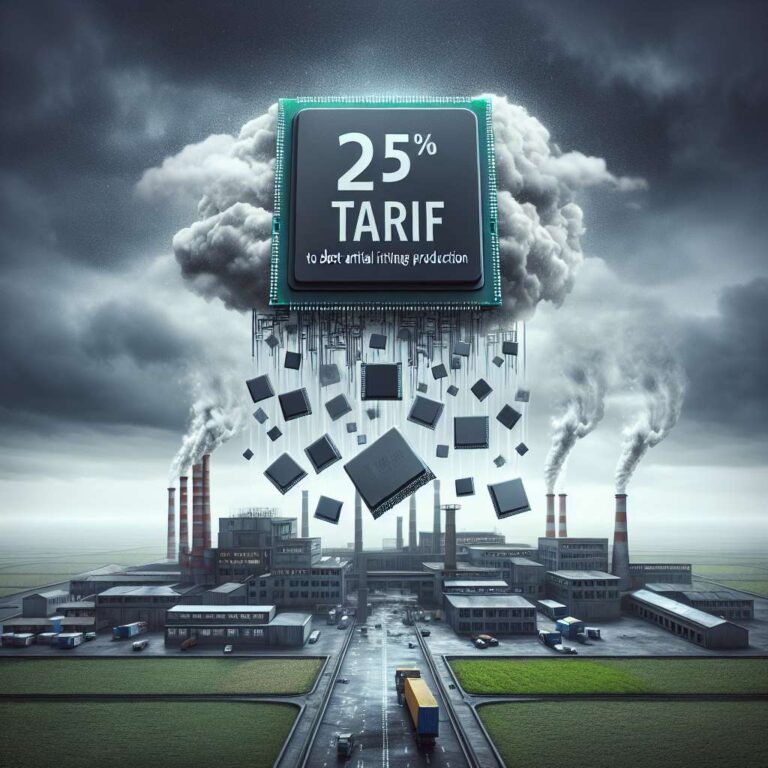
Donald Trump has imposed a 25% tariff on certain artificial intelligence chips, targeting high-end semiconductors such as the Nvidia H200 artificial intelligence processor and AMD’s MI325X under a new national security order issued by the White House. The proclamation follows a nine-month investigation under section 232 of the Trade Expansion Act of 1962 and focuses on semiconductors that meet specific performance benchmarks, as well as devices containing those chips, to be subject to import duties. The administration frames the move as part of a broader strategy to encourage more semiconductor production inside the United States and to reduce dependence on overseas manufacturing hubs such as Taiwan.
The proclamation states that the United States currently fully manufactures only approximately 10 percent of the chips it requires, making it heavily reliant on foreign supply chains, which it describes as a significant economic and national security risk. According to a White House fact sheet, the new tariffs are described as narrowly focused and will not apply to chips and derivative devices imported for United States datacenters, startups, non-datacenter consumer applications, non-datacenter civil industrial applications and United States public sector applications. Commerce secretary Howard Lutnick is granted broad discretion to apply additional exemptions, and early market reaction saw shares of Nvidia, AMD and Qualcomm trade slightly lower in after-hours activity.
The tariff decision arrives alongside other trade actions by the Trump administration aimed at reshaping the semiconductor supply chain and asserting national security justifications. Trump in December said he would slap tariffs on Chinese semiconductor imports over Beijing’s pursuit of chip industry dominance, but delayed the action until June 2027 after a year-long section 301 unfair trade practices investigation initiated under former president Joe Biden. The administration this week also required that China-bound chips detour from Taiwan through the United States for third-party testing, with those chips subject to the same 25% tariff when they enter the country. An annex to the order specifies that any 25% tariff imposed on semiconductors under this proclamation will not be stacked on top of other Trump administration section 232 tariffs and will be exempt from duties on copper, aluminum and steel, and auto and truck parts, even as officials signal that broader semiconductor tariffs may still be considered to further incentivize domestic manufacturing.