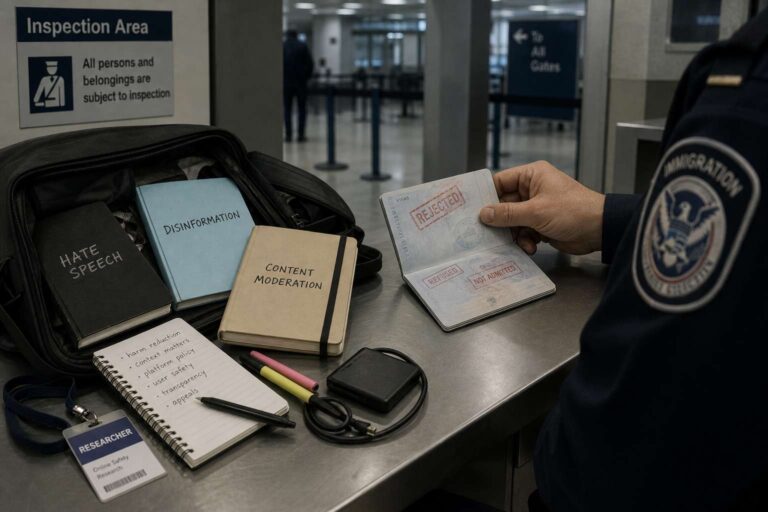
Tech researchers are mounting a legal challenge to a Trump administration visa policy that they say threatens work on hate speech, harassment, propaganda, disinformation, and content moderation. The lawsuit, brought by the Coalition for Independent Technology Research against Secretary of State Marco Rubio, former homeland security secretary Kristi Noem, and former attorney general Pam Bondi, argues that the policy violates the speech and due process rights of foreign-born researchers and technology workers whose work supports stronger platform moderation. The plaintiffs are asking the court to block the restrictions while the case moves forward.
The dispute began after Rubio announced a “visa restriction policy” against “foreign officials and other persons” who were “complicit in censoring Americans.” The administration says the policy is aimed at conduct that assists foreign government censorship of free speech, not protected expression. In court, government lawyers argued that position and later filed a motion to dismiss. The judge has not yet ruled and has focused questions on who is affected by the State Department’s statements and how broadly the policy applies. Plaintiffs say the policy is intentionally vague and has already created a chilling effect across research and trust and safety work.
The administration expanded the policy through several actions. It first deployed the policy in July 2025, when Rubio issued a statement announcing the revocation of visas for Alexandre de Moraes, the lead justice on the Brazilian Supreme Federal Court, and “his allies on the court” who were involved in prosecuting Jair Bolsonaro, Brazil’s former president. Then, in early December, the State Department issued instructions to embassies to reject H-1B visa applications from individuals who had worked specifically in fact-checking, online trust and safety, and mis- or disinformation research. On December 23, the agency announced visa restrictions for five Europeans, including Imran Ahmed of the Center for Countering Digital Hate and Clare Melford of the Global Disinformation Index.
CITR says the consequences are already visible. CITR represents 500 individual and institutional members in 47 countries; 40 are based in the United States, including around 30 noncitizens. According to the group, researchers have changed how they describe their work, moved away from content moderation topics, or left the country to continue their work more safely. Eirliani Abdul Rahman, a Singaporean online safety expert and former member of Twitter’s Trust and Safety Council, said the restrictions and the wider political climate made the United States feel untenable for research on online harms. She later moved to Germany under a six-year fellowship focused on international academic freedom.
The case could have broader implications for how the public learns about the risks tied to social media and advanced technology. Plaintiffs and their lawyers argue that independent researchers play a central role in documenting harms, informing the public, and holding technology companies accountable. That includes recent work by Ahmed’s organization, which found that Grok’s image-editing feature had generated an estimated 3 million sexualized images, including 23,000 images of children, in an 11-day period. Researchers involved in the lawsuit say the outcome will help determine whether independent oversight of major platforms can continue in the United States.