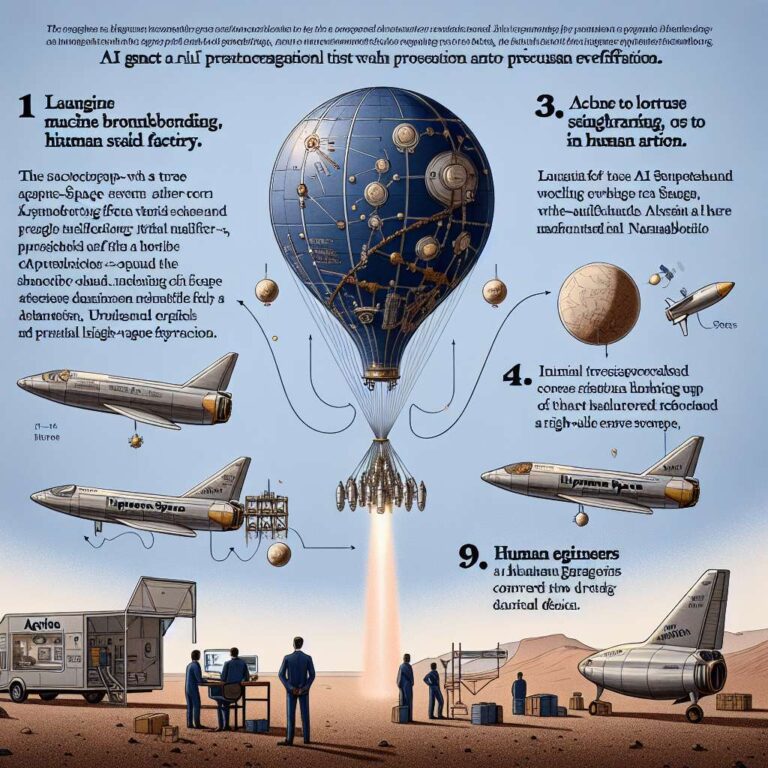
U.K. startup Acme Space is applying a multi agent artificial intelligence system to spacecraft design, claiming it has taken its Hyperion orbital factory vehicle from concept to imminent test flight in less than two years. Hyperion is a reusable spacecraft that will be launched from a stratospheric balloon to deliver payloads and manufacture materials in orbit, including protein crystals for super efficient semiconductors and optical fibers for advanced computing and communications. By replacing the traditional “design – build – test – fail – redesign” cycle that “takes six months” with an artificial intelligence driven loop of “design – AI simulate – fail – AI redesign” that “takes 10 minutes,” founder and CEO Tomas Guryca says the company is compressing aerospace timelines that are typically plagued by delays and overruns.
The development approach relies on three specialized artificial intelligence agents that check and refine one another’s output before human engineers complete the work. The first agent is a creative Hybrid Sparse Dense Retriever based on Meta’s open source Llama 3 large language model, which mines decades of publicly available space patents and recent research to propose novel designs, including ideas extracted from faded “1960s NASA PDFs.” Guryca notes that despite extensive domain specific training, “up to 80 percent” of the model’s raw ideas are “physically unfeasible” and often reflect “alien logic that defies convention.” To contain these hallucinations, a second agent in the form of a Fourier Neural Operator, trained for “months of continuous compute time on our GPU cluster” on complex physics such as cryogenic fluid behavior, evaluates each proposal’s physical validity and iteratively forces corrections until both models agree, a process that Guryca says filters out “98% of hallucinations.”
A third “system consistency guardian” agent then assesses whether the converged design can actually be built, rejecting complex and costly approaches like metal 3D printing in favor of simple geometries, standard catalog parts and conventional processes guided by supply chain and cost data, in line with the “keep it simple, stupid” principle. Acme Space uses reinforcement learning where the agent receives a “reward” for using standard components and a “penalty” for proposing custom machining, so the resulting designs can be produced on standard CNC machinery. Only once all three agents are satisfied do human engineers step in, since “to build prototypes, we really need 100 percent precision” and artificial intelligence generated drawings remain too error prone; instead, engineers turn the models’ precise text specifications into CAD. According to Guryca, this setup cuts staffing needs “by a factor of five,” so that achieving the current pace of development would otherwise require “approximately 50 to 60 senior engineers” instead of the “core team of less than ten.” The system has also surfaced unconventional solutions, including the decision to launch Hyperion from a stratospheric balloon to “bypass the dense, turbulent lower atmosphere” and ignite the rocket in near vacuum, an approach previously attempted by Spanish startup Zero2Infinity. Acme Space plans balloon drop tests in Namibia in the “first half of 2026” and aims for initial orbital flight tests “for the end of 2026” from SaxaVord spaceport in the U.K., offering in orbit manufacturing capacity to semiconductor, optical fiber and pharmaceutical companies.