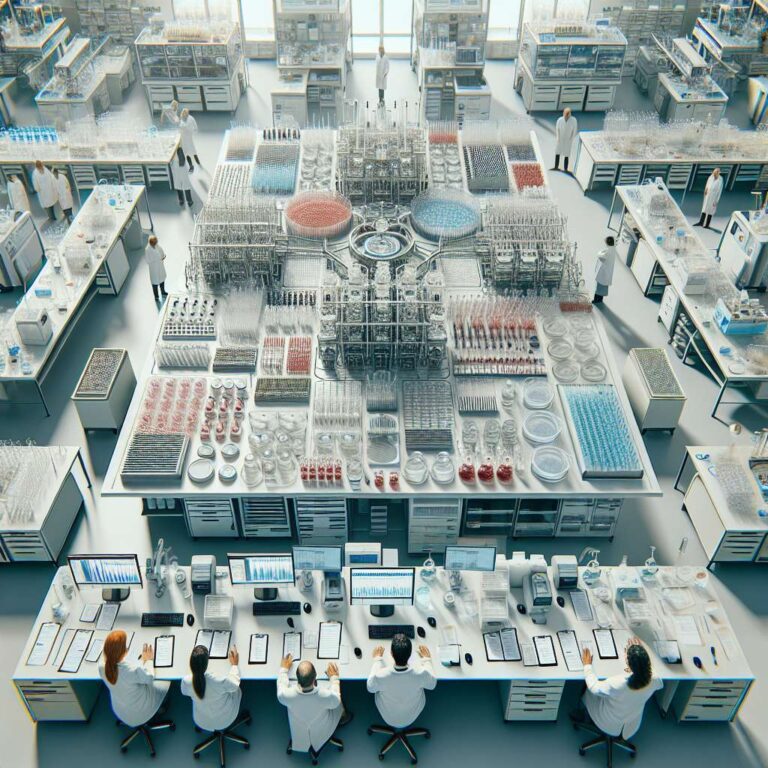
SLAS2026 underscored how high-throughput systems, automation and Artificial Intelligence are reshaping drug discovery and laboratory operations, with a series of product launches and collaborations focused on speed, scale and workflow integration. High-throughput technology provider Carterra introduced the Carterra Vega High-Throughput Surface Plasmon Resonance instrument as the industry’s first 48-channel SPR platform, positioning it for large-scale interaction studies. SPT Labtech and BellBrook Labs announced a collaboration in oncology built around a miniaturised, high-throughput screening platform for discovery and profiling of Vacuolar protein sorting associated protein 4B ATPase inhibitors.
Revvity used the meeting to unveil multiple new discovery platforms and technologies that are designed to accelerate high-throughput drug discovery workflows, reinforcing the event’s emphasis on throughput and automation. Emulate brought its AVA Emulation System to the conference, showcasing a first-of-its-kind high-throughput organ-chip platform intended to speed drug development by better emulating human biology. Charles River Laboratories announced a collaboration with software and assay developer Synthace to advance assay development in drug discovery, reflecting growing interest in software driven experiment design and optimisation.
Sample processing and automation vendors also marked major entries into higher throughput and more integrated workflows. QIAGEN presented the QIAsprint Connect as its entry into high-throughput sample processing, enabling preparation of up to 192 samples per run while reducing plastic consumption. Omega Bio-tek highlighted a new workflow that offers a high-throughput, automation-friendly platform. Promega launched a live-cell target engagement platform that aims to close a long-standing gap between biochemical and cellular assays for understudied or difficult-to-interrogate proteins. Cenevo advanced its vision of agentic labs with the launch of two new Artificial Intelligence agents to accelerate lab operations, while UniteLabs presented an Artificial Intelligence ready lab automation system called The Operating System, which replaces vendor-specific instruments and software with an open, Python-based infrastructure to give lab automation engineers and scientists greater control and transparency over their workflows.