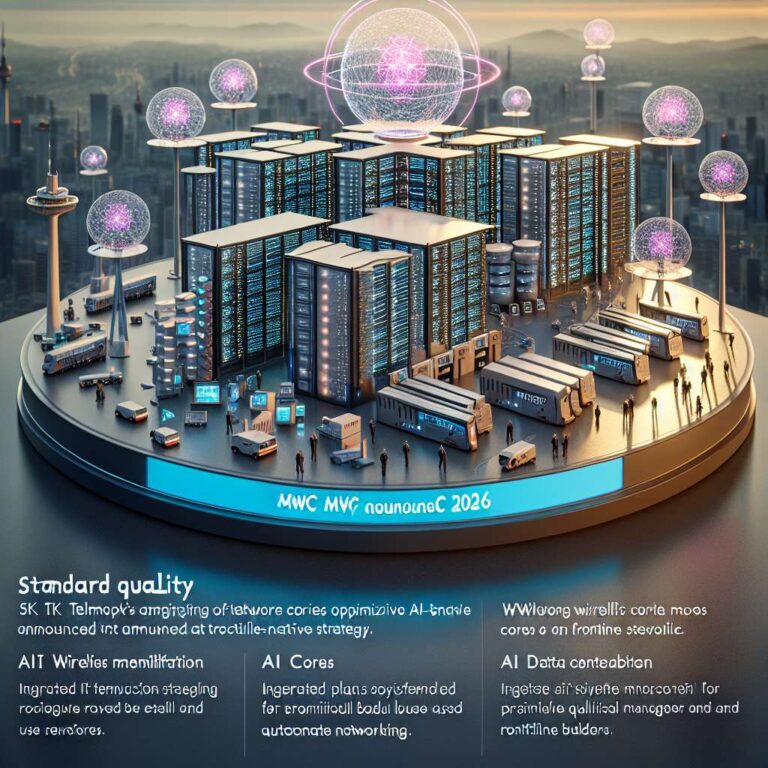
At MWC 2026 in Barcelona, SK Telecom set out an Artificial Intelligence native transformation that reaches from its network core to frontline customer interactions. Chief executive Jung Jai-hun framed the effort as a “golden time of transformation” where “customer value innovation” and “Artificial Intelligence innovation” intersect, with the goal of helping place Korea among the world’s top three Artificial Intelligence powers. The company is rebuilding its integrated IT systems for sales, line management, and billing to be optimised for Artificial Intelligence, so it can design and offer personalised plans and memberships based on individual usage and behaviour. A Zero Trust security framework will be applied across systems with stronger authentication, access controls, network segmentation, and Artificial Intelligence based monitoring, signalling a shift away from legacy telecom stacks and raising new questions about data governance and the use of customer data in training or tuning models.
The operator is extending its “autonomous network operations” strategy by using Artificial Intelligence to automate wireless quality management, traffic control, and network equipment operations, while deploying AI-RAN technology to improve speed and reduce latency. On the customer side, SK Telecom plans to overhaul pricing, roaming, and membership services so they are simpler and more automated, anchored by an integrated Artificial Intelligence agent spanning its T world portal and T Direct Shop online store. The agent will analyse daily usage patterns to deliver tailored suggestions, while an expanded Artificial Intelligence Contact Center will support representatives during calls. Offline retail is included, with Artificial Intelligence tools to help staff identify customer needs after visits and new “Artificial Intelligence Personas” that analyse digital behaviour across segments and support conversational Q&A, reflecting a broader move from reactive to predictive service models.
SK Telecom’s infrastructure roadmap centres on building hyperscale Artificial Intelligence data centres across Korea, targeting capacity that exceeds 1 gigawatt, in a bid to attract global investment and position the country as a major Artificial Intelligence data centre hub in Asia. The company already operates a GPU cluster called Haein and has applied its Petasus AI Cloud virtualisation solution to GPU-as-a-service workloads, which it now intends to offer globally, and it plans to construct an Artificial Intelligence data centre in Korea’s southwestern region in collaboration with OpenAI. SK Telecom said its sovereign Artificial Intelligence foundation model currently has 519 billion parameters, and the company plans to upgrade it to more than one trillion parameters with multimodal capabilities for image, voice, and video in the second half of the year, alongside a manufacturing-focused package with SK hynix that analyses process data in real time to reduce defect rates and improve equipment efficiency. Internally, SK Telecom is tracking Artificial Intelligence usage with an “AX Dashboard,” governing transformation via an “AI Board,” and giving staff an “Artificial Intelligence playground” for no-code agent creation, where more than 2,000 Artificial Intelligence agents are already used across marketing, legal, and public relations, as Jung pledged to fundamentally transform corporate culture to be centred around Artificial Intelligence.