
Seagate HAMR prototype achieves 6.9 TB per platter for 55 TB HDDs

Seagate disclosed a prototype heat-assisted magnetic recording platter that stores roughly 6.9 TB and enables drives with roughly 55 TB of capacity. The company says the technology would benefit data center cold tiers and workloads such as Artificial Intelligence.

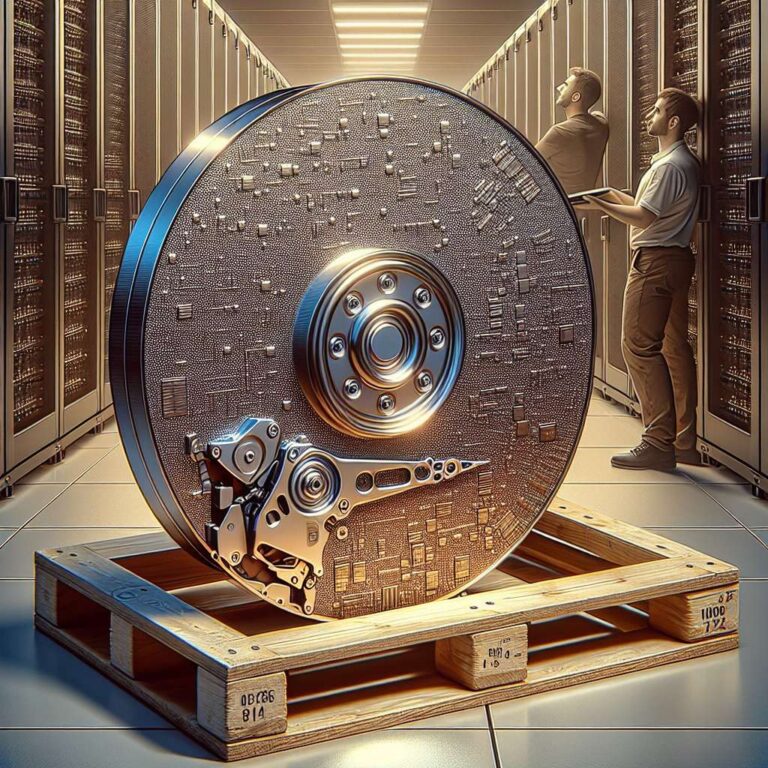
During a conference about a month ago in Japan, Seagate disclosed a milestone for heat-assisted magnetic recording. The company revealed a prototype platter capable of storing roughly 6.9 TB of data and said it has run simulations for platters that reach 8 TB of capacity, though those remain a distant prospect. Seagate’s roadmap points to production-ready platters above 7 TB in the early 2030s and hints at an eventual path toward densities in the neighborhood of 15 TB per platter or more. For now, the 6.9 TB platter enables a HAMR hard disk drive with the capacity of roughly 55 TB. No information on read/write speeds was provided.

This step change in areal density and the prospect of gradual capacity increases matter most where raw capacity and cost per TB are the primary concerns. Use cases called out include data center cold tiers, backup servers, media archives, large network-attached storage arrays and video editing vaults. Drives that pack far more storage into each chassis can reduce the number of required drives, which in turn simplifies array design and management.

Fewer drives in an array can lower power and cooling demands and reduce rack real estate to manage, factors that together can shrink the total cost of ownership for very large storage deployments. That combination is particularly relevant as modern content creation, Artificial Intelligence workloads and other data-heavy applications drive rapidly growing storage requirements. Higher-capacity platters therefore aim to address both density and operational cost pressures for large-scale storage operators.

Seagate’s current prototype demonstrates feasibility at the 6.9 TB level and establishes a development path toward higher densities. The company has signaled production targets above 7 TB in the early 2030s and research targets that include simulated 8 TB platters and potential densities around 15 TB per platter or more. Outside of capacity figures, the announcement did not provide performance metrics or timelines for product availability beyond the roadmap guidance.
55

Impact Score

Report finds California creative job losses are not driven by Artificial Intelligence

New research from Otis College of Art and Design finds California’s recent creative industry job losses stem from cost pressures and structural shifts, not direct worker displacement by generative Artificial Intelligence. The technology is changing workflows and expectations, but it is largely replacing tasks rather than entire jobs.

U.S. senators propose broader chip tool export ban for Chinese firms

A bipartisan proposal in the U.S. Senate would shift semiconductor equipment controls from specific fabs to targeted Chinese companies and their affiliates. The measure is aimed at cutting off access to advanced lithography and other wafer fabrication tools for firms such as Huawei, SMIC, YMTC, CXMT, and Hua Hong.

Trump executive order targets state Artificial Intelligence laws

Executive Order 14365 lays out a federal strategy to discourage, challenge, and potentially preempt state Artificial Intelligence laws viewed as burdensome. Employers are advised to keep complying with current state and local rules while preparing for regulatory uncertainty in 2026.

Who decides how America uses Artificial Intelligence in war

Stanford experts are divided over how the United States should govern Artificial Intelligence in defense, surveillance, and warfare. Their views converge on one point: decisions with such high stakes cannot be left to companies alone.

GPUBreach bypasses IOMMU on GDDR6-based NVIDIA GPUs

Researchers from the University of Toronto describe GPUBreach, a rowhammer attack against GDDR6-based NVIDIA GPUs that can bypass IOMMU protections. The technique enables CPU-side privilege escalation by abusing trusted GPU driver behavior on the host system.

Contact Us

Got questions? Use the form to contact us.

Contact Form

Clicking next sends a verification code to your email. After verifying, you can enter your message.