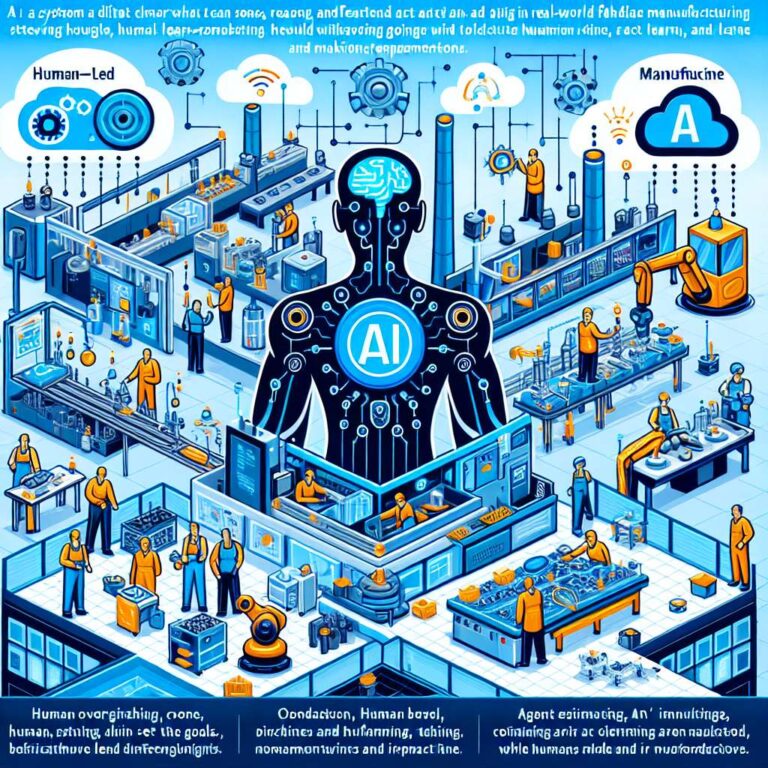
Manufacturers are entering a new phase where automation alone is no longer sufficient to address labor shortages, rising complexity, and mounting pressure to innovate without compromising safety or quality. The focus is shifting from isolated Artificial Intelligence tools and standalone robots to physical Artificial Intelligence, defined as intelligence that can sense, reason, and act in the real world. This approach emphasizes human led, Artificial Intelligence operated systems where people set intent and intelligent systems execute, learn, and improve in dynamic physical environments.
Early adoption of Artificial Intelligence in industry largely centered on cost cutting and efficiency, which often introduced new friction such as skills gaps and governance concerns while delivering limited strategic value. The emerging industrial frontier reframes the question from how much work machines can replace to how Artificial Intelligence can augment human capability, accelerate innovation, and unlock new value while remaining controllable. Success in this frontier depends on two non negotiables: intelligence, meaning Artificial Intelligence systems must understand real business data, workflows, and institutional knowledge, and trust, meaning organizations must maintain security, governance, and observability as Artificial Intelligence systems begin to act in high stakes environments.
Manufacturing is positioned as the proving ground for this transition because Artificial Intelligence is moving into physical execution, coordinating machines, adapting to variability, and working alongside people on the factory floor. Traditional automation handles repetition well but struggles with adaptability, while human workers bring judgment yet cannot scale indefinitely; physical Artificial Intelligence is framed as the bridge between the two. Microsoft and NVIDIA are collaborating to provide the infrastructure, with NVIDIA supplying accelerated computing, open models, simulation libraries, and robotics frameworks, and Microsoft delivering a cloud and data platform to run physical Artificial Intelligence securely across the enterprise. Together they aim to help manufacturers move from pilots to production ready, agentic systems that span product lifecycle, operations, and supply chains.
Within factories, Artificial Intelligence agents are envisioned as digital teammates that are grounded in operational data, embedded in human workflows, and governed end to end. These agents can optimize production lines in real time, coordinate maintenance and quality decisions, adapt to supply or demand disruptions, and accelerate engineering and product lifecycle choices, often by using simulation to test changes virtually before deployment. Human oversight remains central: Artificial Intelligence executes, monitors, and recommends, while people retain control over intent and judgment, allowing organizations to move faster without losing confidence. As physical Artificial Intelligence systems scale, trust is identified as the limiting factor, making built in security, observability, policy adherence, and governance essential for safety and mission critical processes. The convergence of Artificial Intelligence agents, robotics, simulation, and real time data is described as an inflection point, with Microsoft and NVIDIA planning to demonstrate deployable and scalable physical Artificial Intelligence systems at NVIDIA GTC 2026, and manufacturing leaders urged to adopt these capabilities responsibly and at scale with trust designed in from the start.