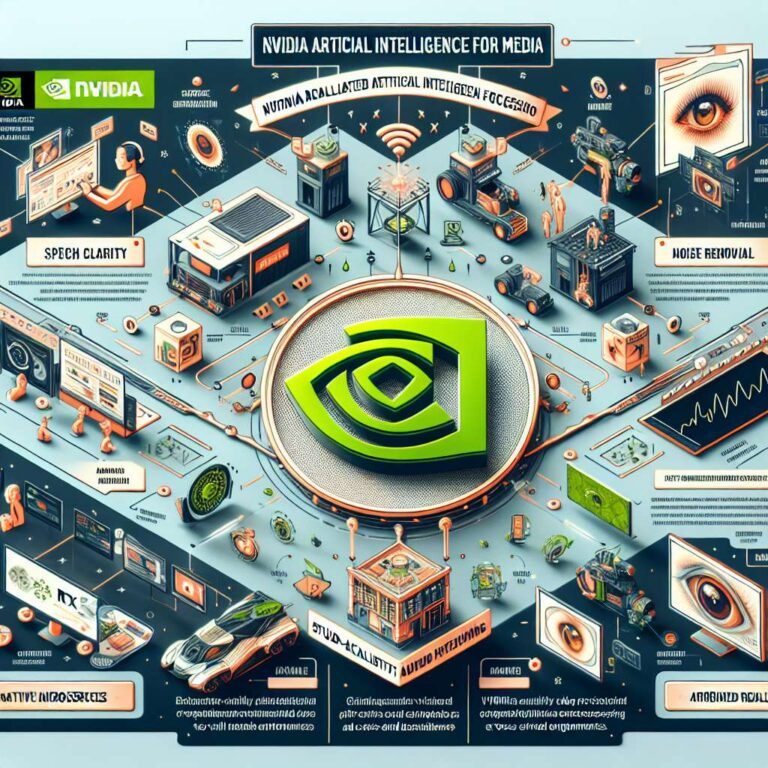
NVIDIA Maxine is now called NVIDIA Artificial Intelligence for Media, with access to NIM microservices, SDKs, and early access programs continuing without interruption. The platform provides SDKs and cloud-native microservices that enhance audio, video, and augmented reality effects for media and entertainment workflows. Built on the NVIDIA Artificial Intelligence platform, it is designed to deliver studio-quality audio and high-resolution video enhancement and effects for real-time audio and video pipelines, from local systems to cloud environments.
NVIDIA positions Artificial Intelligence for Media as a low-latency developer platform for content creation, livestreaming, broadcast, and remote production. It supports deployment on premises, in the cloud, or at the edge, and with NVIDIA NIM, part of NVIDIA Artificial Intelligence Enterprise, developers can access these capabilities as microservices for secure, reliable, and high-performance deployment across clouds, data centers, and workstations. Core benefits include pretrained models for augmented reality, audio, and video quality features, accelerated inference on NVIDIA RTX GPUs, and complete enhancement pipelines that chain together multiple low-latency effects.
The platform highlights several media use cases. For livestreaming, it focuses on enhancing audio and video quality in real time in bandwidth-constrained environments, including audio cleanup, video upscaling, relighting, and visual effects. For professional broadcast, it adds speech processing, visual enhancement, and speaker intelligence, supports ST 2110, and integrates with NVIDIA Holoscan for Media. For content creation, it offers RTX-accelerated improvements to speech clarity, noise removal, video resolution, and augmented reality features, aimed at creator tools and production workflows without requiring specialized equipment or complex post-production.
Recent and upcoming capabilities include Relighting NIM, Synthetic Video Detector NIM, Lip Sync NIM, Active Speaker Detection NIM, Background Noise Removal NIM, Studio Voice NIM, LipSync, RTX Video Super Resolution, and 3D Body Pose. Synthetic Video Detector is described as producing results in real time on NVIDIA RTX GPUs, while several services are marked Coming Spring 2026. RTX Video Super Resolution upscales 16:9 video from 480p to as high as 8K using Artificial Intelligence, and 3D Body Pose provides single-camera, marker-less, rig-free motion capture for full-body 3D animation. NVIDIA also offers Audio Effects SDK, Video Effects SDK, and Augmented Reality SDK, alongside API catalog access, a free evaluation license for a 90-day trial, and a limited early access program for new features.