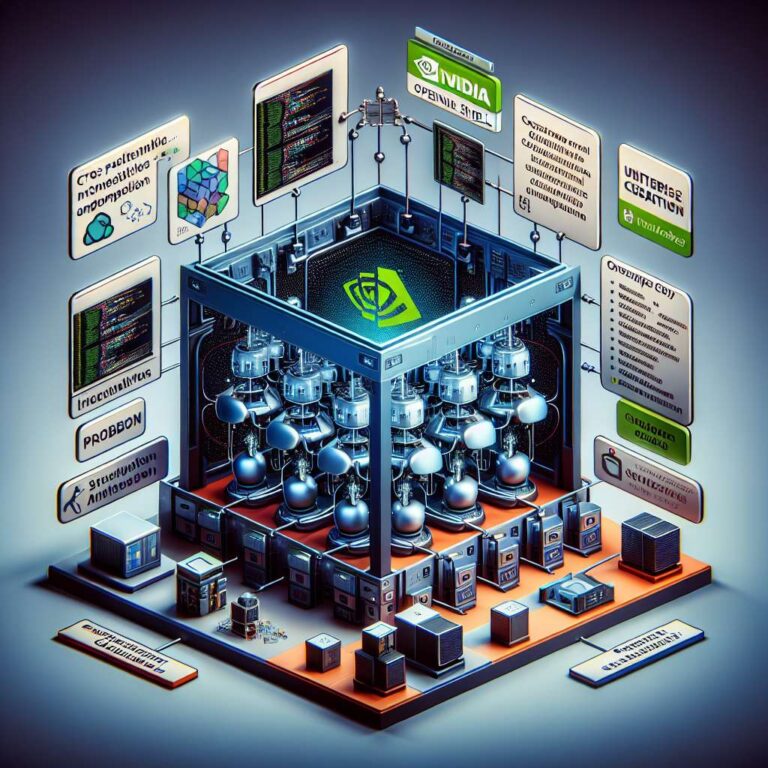
Autonomous agents are moving beyond response generation and reasoning into direct action across files, tools, code execution, and enterprise workflows. That broader operational scope increases application-layer risk as agents continuously improve and evolve. NVIDIA OpenShell is being built to address that challenge as an open source runtime for running autonomous agents such as claws.
OpenShell is part of NVIDIA Agent Toolkit and is designed around a secure-by-design model. Each agent runs inside its own sandbox, separating application-layer operations from infrastructure-layer policy enforcement. Security policies are applied at the system level rather than through behavioral prompts, which keeps them out of the agent’s reach. The runtime enforces constraints on the environment the agent runs in, so the agent cannot override policies or leak credentials or private data even if compromised.
The platform is intended to let enterprises separate agent behavior, policy definition and policy enforcement. Organizations get a unified policy layer to define and monitor how autonomous systems operate. Coding agents, research assistants and agentic workflows can run under the same runtime policies regardless of host operating system, which is intended to simplify compliance and operational oversight. NVIDIA describes the approach as a browser tab model for agents, where sessions are isolated, resources are controlled and permissions are verified by the runtime before any action takes place.
NVIDIA is also building an ecosystem around the runtime. OpenShell is designed to add privacy and security controls for Artificial Intelligence agents, and NVIDIA is collaborating with Cisco, CrowdStrike, Google Cloud, Microsoft Security and TrendAI to align runtime policy management and enforcement for agents across the enterprise stack.
For personal assistant use cases, NVIDIA NemoClaw serves as an open source reference stack that simplifies installing OpenClaw always-on assistants with the OpenShell runtime and NVIDIA Nemotron models in a single command. NemoClaw is positioned as a reference for building self-evolving personal Artificial Intelligence agents, with policy-based privacy and security guardrails that users can customize for specific use cases. It includes an example OpenShell configuration defining how the agent should interact with systems and supports running more securely in clouds, on premises or on personal computers, including NVIDIA GeForce RTX PCs and laptops, NVIDIA RTX PRO-powered workstations, and NVIDIA DGX Station and NVIDIA DGX Spark Artificial Intelligence supercomputers.
Both OpenShell and NemoClaw are in early preview. NVIDIA says it is building in the open with the community and partners to help enterprises scale self-evolving, long-running autonomous agents safely, confidently and in compliance with global security standards.