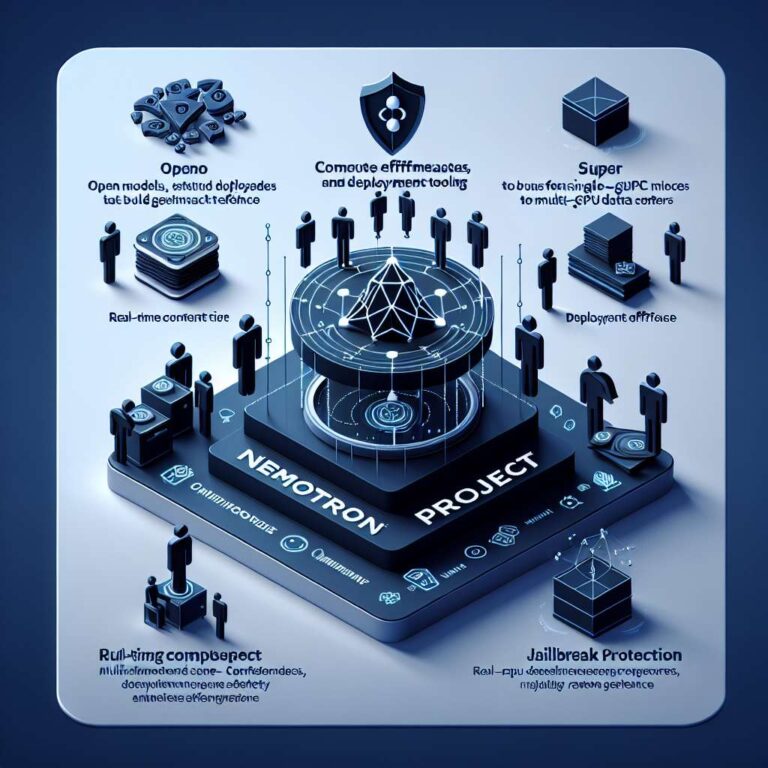
Nvidia Nemotron is a family of open models, datasets, and technologies for building specialized agentic Artificial Intelligence systems. Designed for advanced reasoning, coding, visual understanding, safety, and information retrieval, Nemotron models are openly available and integrated across the Artificial Intelligence ecosystem for deployment from edge to cloud. With transparent training data and broad platform support, Nemotron aims to make it easier to create trustworthy, high‑performance Artificial Intelligence agents.
The portfolio emphasizes four benefits. First, open models: Nvidia publishes model weights, training data, and optimization techniques on Hugging Face, providing transparency and adaptability. Second, high compute efficiency: pruned models are optimized with Nvidia TensorRT‑LLM to increase throughput and support reasoning that can be toggled on or off. Third, high accuracy: built on popular open reasoning models, post‑trained with high‑quality data, and aligned for human‑like reasoning, Nemotron models are presented as achieving the highest accuracy on leading benchmarks. Fourth, secure and simple deployment: optimized Nvidia NIM microservices provide peak inference performance with flexible options for security, privacy, and portability.
Nemotron covers diverse workloads. Reasoning models are offered in three tiers: Nano for PC and edge devices with superior accuracy, Super for high accuracy and throughput on a single Nvidia Tensor Core GPU, and Ultra for the best accuracy on complex, multi‑GPU data center systems. Retrieval‑augmented generation is supported through extraction, embedding, and reranking for enterprise data pipelines. Guardrails arrive as Nemotron Safety Guard models that provide real‑time protection against harmful content, off‑topic drift, and jailbreaks, adding multilingual moderation and cultural alignment. Research models are available for experimentation.
The stack includes Nvidia NeMo to build, customize, and deploy generative and agentic Artificial Intelligence with data curation, scalable ingestion, retrieval‑augmented generation, and performance acceleration; Nvidia NIM to speed deployment with stable, secure APIs and enterprise support; and Nvidia Blueprints to accelerate development with reference applications, partner microservices, agent implementations, documentation, and Helm charts. Getting started options include free prototyping with NIM API endpoints powered by DGX Cloud, and engaging Nvidia Artificial Intelligence Enterprise for production support. Enterprises highlighted as adopters include Accenture, Amdocs, Cadence, CrowdStrike, Deloitte, SAP, ServiceNow, SoftServe, and World Wide Technology.
FAQs clarify that Nemotron models are open source, with Nvidia releasing datasets, techniques, and weights. The Nvidia Open Model License allows using, modifying, distributing, and commercially deploying models and derivatives without attribution. Models can be downloaded from Hugging Face and run for free in production, while NIM microservices require a Nvidia Artificial Intelligence Enterprise license. For production scale, Nvidia provides tools such as Nvidia Dynamo, TensorRT‑LLM, and NIM, and the models can also run with open‑source libraries like SGLang and vLLM.