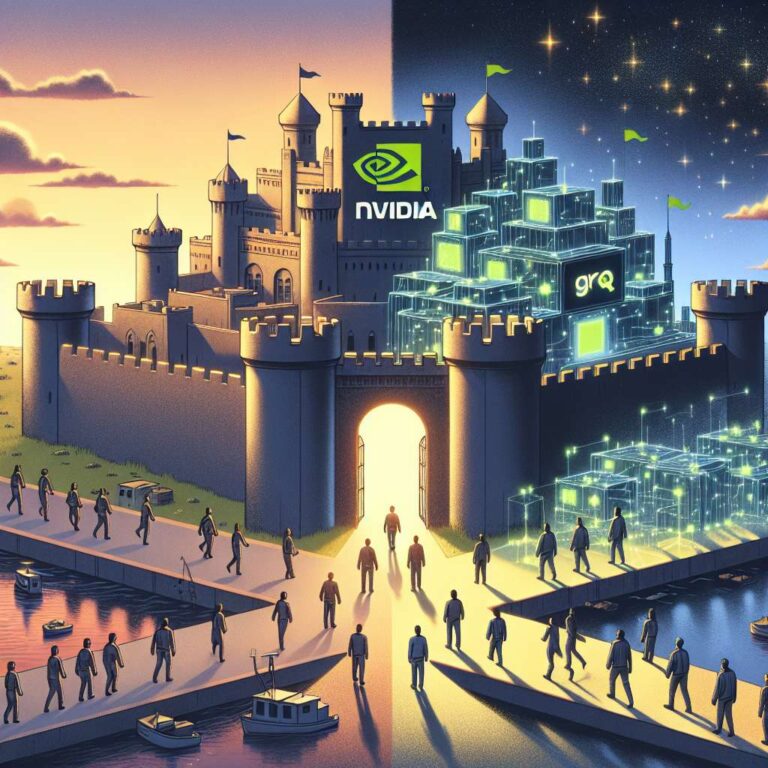
Nvidia’s $20 billion licensing agreement with Groq, described as a non-traditional “acqui-hire,” gives the chipmaker a non-exclusive, perpetual license to Groq’s Language Processing Unit technology while bringing founder Jonathan Ross, president Sunny Madra, and key engineers in-house. The structure lets Nvidia fold Groq’s deterministic, low-latency inference architecture into its roadmap without triggering conventional merger scrutiny, reinforcing its lead in artificial intelligence inference and raising concerns over how far such hybrid deals can stretch antitrust boundaries. By retaining Groq as a nominally independent entity, Nvidia is seen as preserving a “fiction of competition” similar to strategies attributed to Microsoft and Amazon in other technology transactions.
Strategically, Nvidia is using licensing rather than outright acquisition to capture Groq’s single-core LPU design and on-chip SRAM approach, which had been positioned as a distinct alternative to its own GPU-centric model. Analysts argue this combination puts Nvidia in position to dominate both training and inference workloads as the artificial intelligence industry pivots toward real-time processing. The planned integration of LPU-style features into Nvidia’s upcoming “Vera Rubin” chips signals an effort to define the next phase of artificial intelligence hardware, while also neutralizing Groq as a standalone challenger that once posed a unique low-latency threat. Critics contend that Nvidia’s strong free cash flow and balance sheet are enabling an aggressive consolidation of intellectual property that rivals such as AMD and Intel may struggle to counter.
The deal is unfolding as regulators in the U.S. and EU sharpen their focus on non-traditional transactions, including acqui-hires and licensing-heavy structures that can remove would-be competitors without classic merger filings. Observers see parallels between the Groq arrangement and Microsoft’s licensing of Inflection artificial intelligence assets, and note it comes amid broader enforcement experiments like HPE’s $14 billion acquisition of Juniper Networks, where authorities pushed targeted divestitures and software licensing to preserve rivalry. Antitrust experts warn that if market concentration in artificial intelligence hardware continues to climb, enforcers such as the U.S. Department of Justice and the European Commission could move more aggressively against what they describe as “killer acquisitions” and similar hybrid deals. For investors, the Groq transaction underscores Nvidia’s willingness to use financial strength and creative dealmaking to extend leadership, while also heightening the risk that future regulatory or competitive pushback could challenge an increasingly central position in the artificial intelligence ecosystem.