Nvidia and General Atomics, working with an international team and U.S. supercomputing centers, announced a high-fidelity, Artificial Intelligence enabled digital twin for fusion reactors with interactive performance. The collaboration, revealed at the Nvidia GTC Washington, D.C., conference, trained three surrogate models at scale on the Polaris system at the Argonne Leadership Computing Facility and the Perlmutter system at the National Energy Research Scientific Computing Center. Technical support also came from the San Diego Supercomputer Center at the UC San Diego School of Computing, Information and Data Sciences, the Argonne Leadership Computing Facility and NERSC.
The project uses the Nvidia Omniverse platform, Nvidia CUDA-X libraries and data center GPUs to tackle fusion’s central challenge: controlling and predicting plasma behavior fast enough to keep reactors stable. “The ability to explore scenarios virtually through this interactive digital twin is a game-changer,” said Raffi Nazikian, fusion data science lead at General Atomics. “Working with Nvidia, we can now test, refine and verify our ideas orders of magnitude faster, accelerating the path toward practical fusion energy.” By shifting compute-heavy work to Artificial Intelligence, teams can move from weeks-long simulations to answers in seconds.
General Atomics is deploying Artificial Intelligence surrogate models trained on decades of experimental data to predict plasma behavior in near real time. The models include EFIT for plasma equilibrium, CAKE for plasma boundary and ION ORB for the heat density of escaping ions. Running on Nvidia GPUs, these models deliver accurate predictions faster than traditional physics-based simulations, helping operators keep plasma stable and reducing the risk of reactor damage. The approach supports both simulation and control, and is part of ongoing research at the U.S. Department of Energy’s DIII-D National Fusion Facility.
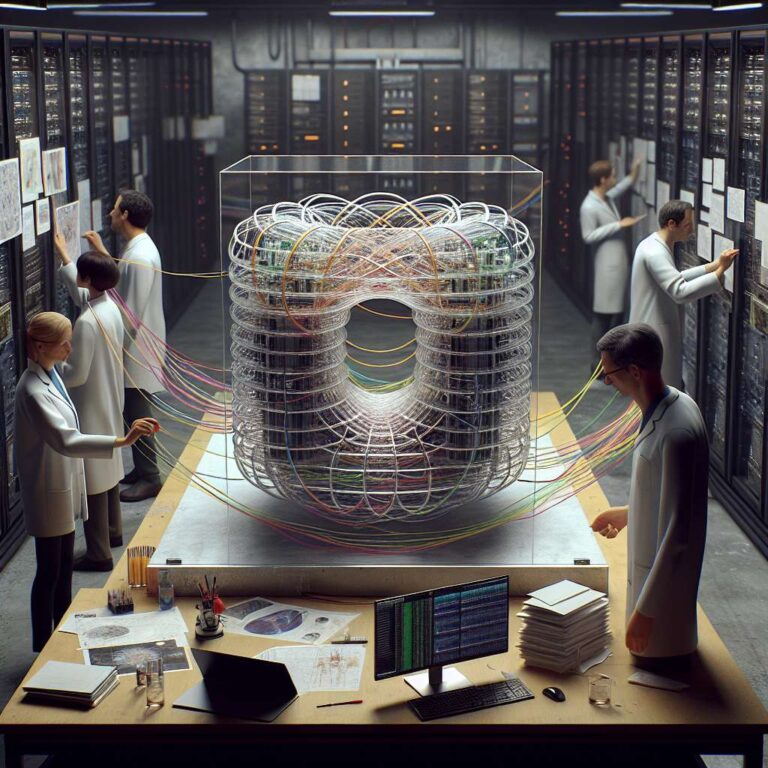
The partners are building a fully interactive digital twin of DIII-D inside Nvidia Omniverse, powered by Nvidia RTX PRO Servers and Nvidia DGX Spark. The virtual reactor fuses live sensor data, physics-based simulations, engineering models and Artificial Intelligence surrogates into a unified environment that informs decisions in real time. Synchronized with the physical DIII-D machine, it enables a global community of 700 scientists from 100 organizations to run what-if scenarios and explore key controls without touching the real reactor.
This computing-first approach reframes fusion research as a joint challenge of physics, data and algorithms. By delivering near real-time, interactive insights, the digital twin serves as a fusion accelerator that can speed idea testing, inform reactor optimization and bring commercial fusion energy closer to viability.