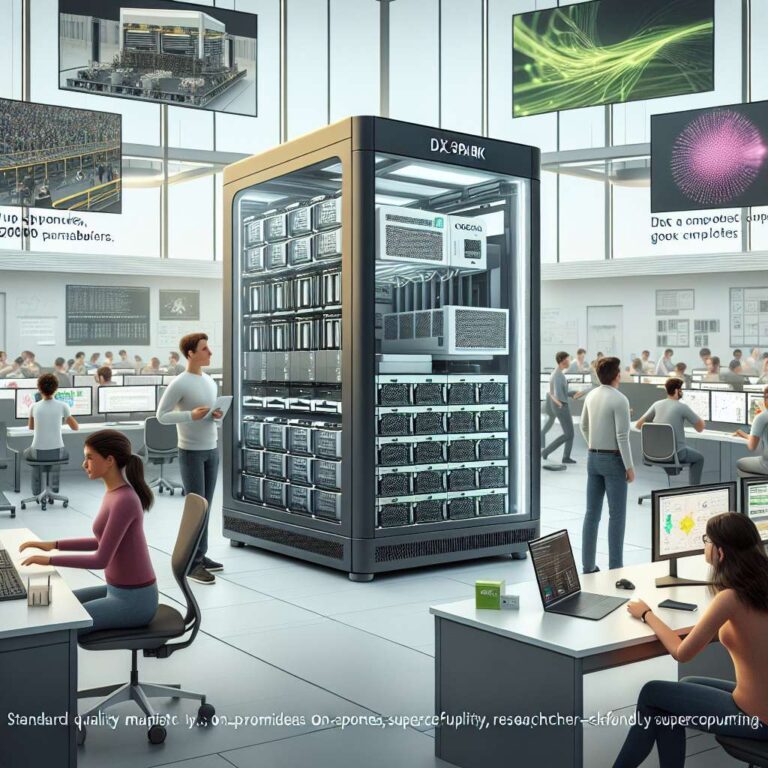
Nvidia’s DGX Spark desktop supercomputer is being deployed at leading universities worldwide to provide data center class Artificial Intelligence capabilities in compact, on premises systems. Powered by the Nvidia GB10 superchip and the Nvidia DGX operating system, each unit supports Artificial Intelligence models of up to 200 billion parameters and integrates with the Nvidia Nemo, Metropolis, Holoscan and Isaac platforms. The petaflop class performance lets researchers and students run large Artificial Intelligence applications locally, from clinical report evaluators to robotics perception systems, while keeping sensitive data on site and reducing iteration times.
At the IceCube Neutrino Observatory at the University of Wisconsin Madison in Antarctica, DGX Spark runs Artificial Intelligence models that analyze neutrino data to study the universe’s most extreme events, complementing traditional astronomy that observes about 80% of the known universe. Researchers highlight that there is no hardware store in the South Pole, which is technically a desert, with relative humidity under 5% and an elevation of 10,000 feet, so DGX Spark’s compact, low power design enables compartmentalized Artificial Intelligence deployment in an extremely remote environment. At NYU’s Global Artificial Intelligence Frontier Lab, the ICARE project runs end to end on a DGX Spark, using collaborating Artificial Intelligence agents and multiple choice question generation to evaluate how closely Artificial Intelligence generated radiology reports match expert sources, enabling real time clinical evaluation without sending imaging data to the cloud.
Harvard’s Kempner Institute uses DGX Spark as a desktop supercomputer to study how genetic mutations in the brain drive epilepsy, analyzing about 6,000 mutations in excitatory and inhibitory neurons and building protein structure and neuronal function prediction maps that inform which variants to test in the lab. Arizona State University, among the first to receive multiple DGX Spark systems, uses them for campus wide Artificial Intelligence research in areas such as memory care, transportation safety and sustainable energy, including powering perception and robotics projects like Artificial Intelligence enabled search and rescue robots and tools for visually impaired users. Mississippi State University uses DGX Spark as a hands on training platform for future Artificial Intelligence engineers, while the University of Delaware’s first Ascent GX10 powered by DGX Spark is described as transformative for research by enabling sports analytics and coastal science teams to run large Artificial Intelligence models on campus instead of relying on costly cloud resources.
At the Institute of Science and Technology Austria, an HP ZGX Nano Artificial Intelligence Station based on DGX Spark is used to train and fine tune large language models on a desktop, with the open source LLMQ software supporting models of up to 7 billion parameters. Because the ZGX Nano includes 128GB of unified memory, the entire model and training data can reside on the system, avoiding complex memory juggling and helping teams move faster while keeping sensitive data local. Stanford University researchers rely on DGX Spark to prototype complete training and evaluation pipelines for Biomni biological agent workflows before scaling to large GPU clusters, reporting that DGX Spark delivers performance similar to big cloud GPU instances, at about 80 tokens per second on a 120 billion parameter gpt oss model at MXFP4 via Ollama, while keeping workloads on a desktop. DGX Spark systems will also support student innovation at Stanford’s Treehacks hackathon, highlighting how desktop supercomputers are becoming a hub for higher education Artificial Intelligence research and experimentation.