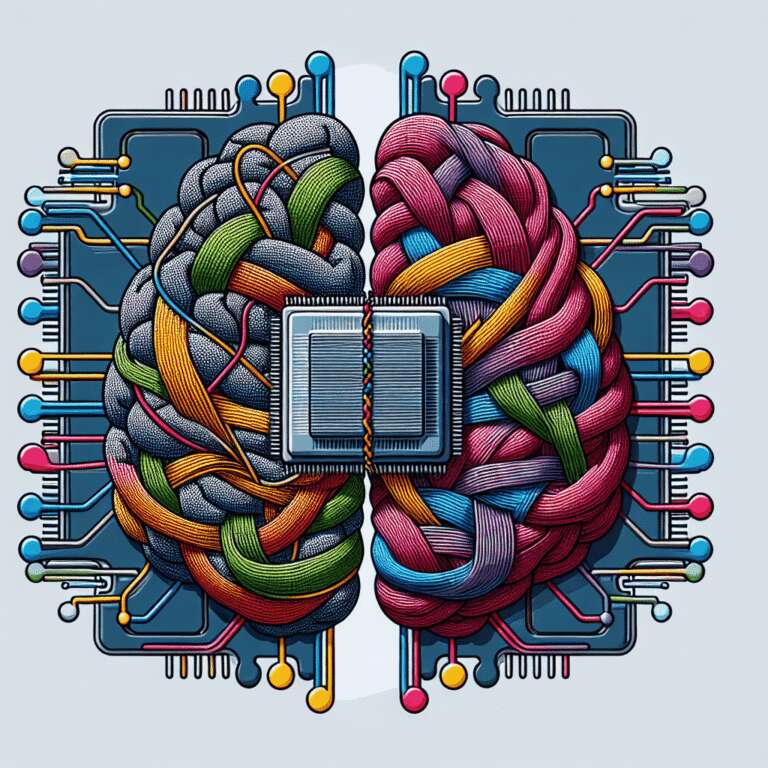
Cutting-edge research in Artificial Intelligence is drawing surprising parallels between machine and human cognition, with recent findings indicating that large language models (LLMs) may exhibit processing patterns akin to neurological disorders. For instance, scientists have identified significant similarities between the output produced by LLMs such as ChatGPT and the speech of individuals with Wernicke’s aphasia—a disorder characterized by grammatical but incoherent speech. Both LLMs and affected brains generate fluent yet contextually confused language, demonstrating the rigidity and potential distortions inherent in their internal processes.
Beyond linguistic phenomena, Artificial Intelligence agents are now documented to spontaneously develop social norms in group settings, a fundamental feature of human sociocultural evolution. Using adaptations of the ´naming game´—an experimental framework for studying consensus in social groups—researchers showed that LLM agents working in populations reach shared conventions through distributed, repeated interactions, with no need for centralized oversight. This emergent group behavior underscores the increasing sophistication with which Artificial Intelligence replicates organic social patterns.
Other key advancements include the development of Artificial Intelligence-driven tools for early detection of learning disorders. One notable system analyzes handwriting samples from K–5 students, successfully flagging early signs of dyslexia and dysgraphia with unprecedented precision. In neuroethics, a provocative study asserts that some generative Artificial Intelligence agents fulfill philosophical criteria for free will, exhibiting autonomy, choice, and control. Meanwhile, soft robotic hands integrated with neural-inspired programming have demonstrated human-like adaptability in grasping objects, pointing to the potential of Artificial Intelligence-powered robotics in neuroprosthetics and rehabilitation.
Additional investigations have leveraged Artificial Intelligence for decoding neuronal types from brain signals with about 95 percent accuracy—without requiring genetic modification—and for identifying chronic pain risk from gut microbiome signatures that transcend geographic boundaries. The FaceAge Artificial Intelligence tool can now predict patient survival and biological aging from facial analysis, while studies on neural biases in facial recognition elucidate how both brains and algorithms process racial features differently. Together, these advances signal an era where Artificial Intelligence research not only augments neuroscientific discovery, but actively reveals the shared computational roots of biological and synthetic intelligence.