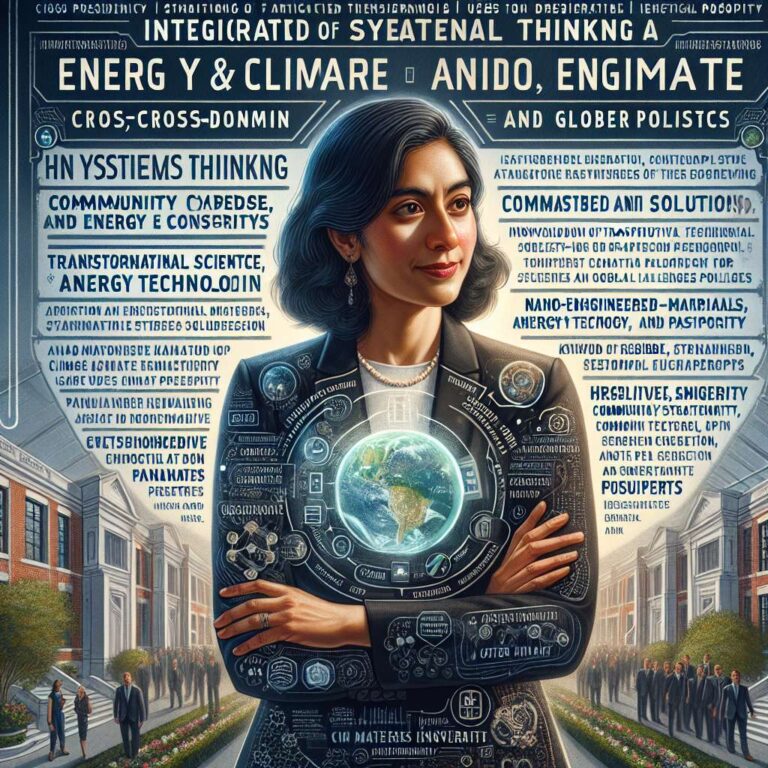
Evelyn Wang’s early experience of water shortages in Southern California shaped a lifelong awareness of resource scarcity, and she is now leading MIT’s effort to confront the intertwined challenges of climate change and global energy demand as the Institute’s inaugural vice president for energy and climate. After serving as director of the US Department of Energy’s Advanced Research Projects Agency-Energy, she returned to the campus where she has deep family and professional roots to coordinate MIT’s expanding work across climate science, energy technology, and policy. MIT leaders frame her appointment as a response to an accelerating climate crisis and a signal that the Institute intends to elevate and integrate its climate and energy agenda across departments, initiatives, and external partners.
A mechanical engineer whose research spans thermal management, energy conversion and storage, nano-engineered materials, and water harvesting, Wang has helped develop devices such as a nanophotonic crystal system that could double the efficiency of solar cells and a water harvester that can extract liquid from very dry air. She argues that energy and climate are “two sides of the same coin,” noting that the world’s failure to deploy solutions at sufficient scale has allowed emissions from the energy sector to drive climate change while energy demand keeps rising. She contends that switching from fossil fuels to cleaner sources is necessary but insufficient, and calls for transformational approaches that also consider environmental impacts of new fuels, smarter movement of goods and energy, novel ways to raise food and use food waste to sequester carbon, and large-scale systems thinking that cuts across technology, policy, finance, and social science.
Wang emphasizes that addressing lingering “energy poverty” and the explosive growth of Artificial Intelligence data centers will further increase electricity demand, but she believes Artificial Intelligence itself can help by improving grid management, accelerating discovery of catalysts and chemicals, stabilizing fusion plasmas, enhancing climate and geospatial modeling, and even reducing computational needs to lower cooling loads. Within MIT, she sees her role as amplifying and connecting substantial existing efforts, including hundreds of researchers involved in Institute-wide climate initiatives and multiple flagship projects aimed at early disaster warning, extreme weather preparedness, and steep cuts in industrial carbon emissions. She is promoting a cultural shift from “1,000 flowers blooming” toward coordinated, systems-level collaboration, backed by new Climate Project grants for cross-department faculty teams and student groups, and by efforts to build defined partnerships with other universities, industry, investors, and philanthropists.
Wang frames the work around human well-being rather than abstract climate metrics, urging colleagues to design solutions that help communities thrive under changing conditions through resilient housing, cooler and healthier living environments, and decarbonized infrastructure such as ports, shipping, and data centers. She champions a problem-first mindset that questions default answers, such as assuming higher-density batteries are the only path to extending electric vehicle range. Her holistic vision is widely endorsed by MIT peers, who point to her ability to bridge fundamental science and real-world applications, learn new fields quickly, and lead diverse teams on complex problems. Her experience at ARPA-E gave her a national-scale perspective on high-risk, high-reward “moonshot” projects and taught her how difficult it is to move game-changing ideas from concept to deployment through a fragmented innovation ecosystem.
Wang must pursue this agenda amid a tightening federal funding environment, with proposed large cuts to US climate and energy research agencies, canceled missions, and terminated projects that include programs at ARPA-E, all of which threaten universities that depend on government support. She acknowledges the near-term challenges but insists on focusing on long-term solutions, arguing that MIT must continue to advocate for research and education while seeking common ground with policymakers on shared interests such as national security, critical minerals, economic competitiveness, and nuclear and geothermal power. She envisions MIT as both a “factory of ideas” and a convener that pilots targeted, community-specific solutions rather than one-size-fits-all models like universal solar deployment, then uses successful pilots as templates elsewhere. Above all, she wants colleagues to stay bold and hopeful, building practical demonstrations that show a resilient, sustainable, and prosperous future is achievable.