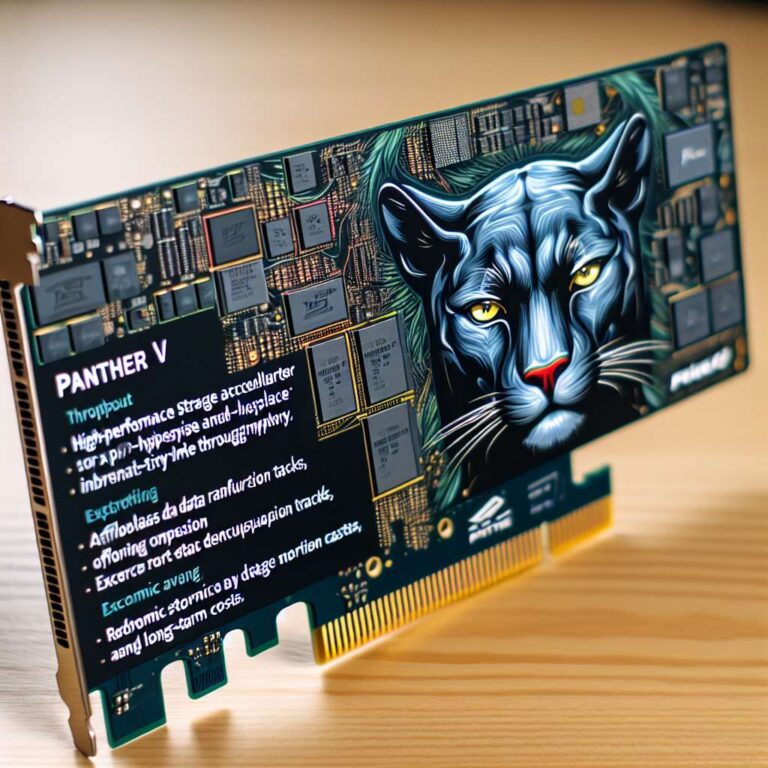
MaxLinear has announced the Panther V, its latest high-performance storage accelerator designed for the demanding needs of enterprise and hyperscale data centers. The Panther V boasts ultra-low latency and an industry-leading 450Gbps throughput, underpinned by a PCIe Gen 5 x16 interface. It joins the spotlight at the upcoming Future of Memory and Storage 2025 conference in Santa Clara, where MaxLinear will unveil real-world demonstrations highlighting the system´s efficiency and scalability.
Engineered as a significant evolution of the previous Panther III model, Panther V more than doubles throughput while optimizing both capital (CAPEX) and operational (OPEX) expenses for modern data operations. By employing specialized hardware to take over compute-heavy data transformation processes—including compression, deduplication, encryption, and real-time verification—the Panther V offloads these tasks from CPUs. This approach yields tangible gains in performance, slashes storage costs, and drives down energy consumption, outperforming software-centric, FPGA-based, and competing hardware solutions.
At the core of Panther V’s value is its substantial 12:1 data reduction capability, streamlining storage demands for organizations bombarded by swelling datasets. The accelerator’s blend of speed, efficiency, and hardware-level security enhancements positions it as a critical asset for organizations seeking to improve reliability and performance in cloud-scale storage environments. With MaxLinear bringing Panther V to market, the competitive landscape in storage acceleration technology tightens, promising next-generation infrastructure for artificial intelligence, analytics, and high-throughput enterprise workloads.