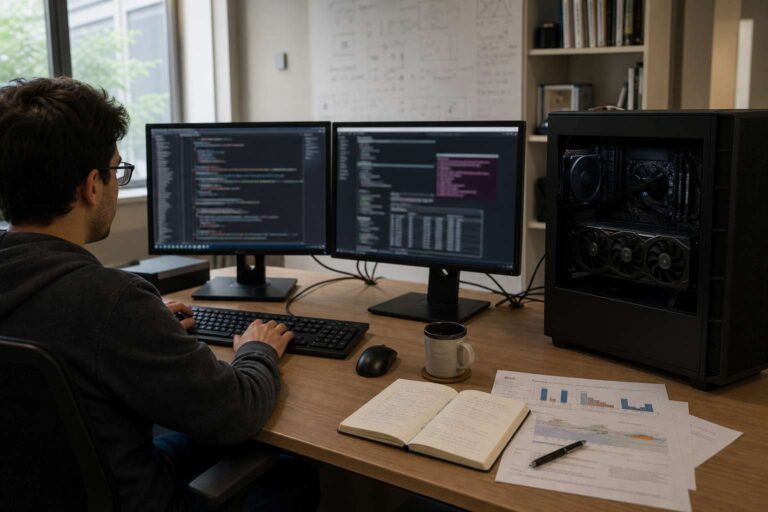
Local language model inference has shifted from a niche technical project into a practical option for developers, researchers, and AI enthusiasts. Newer open-source models including Gemma 4, Qwen 3, and coding-focused variants can support agentic coding, multi-step reasoning, and tool calling with far better speed and accuracy than earlier local systems.
Gemma 4’s 12B quantization-aware trained variant is presented as a standout for consumer hardware, while local agentic coding stacks using Pi, LM Studio, and similar tools can reach approximately 75% of the accuracy and speed of frontier models. Practical setups still depend heavily on hardware: a GPU with at least 12-16GB of VRAM is described as the minimum, while an RTX 4090 can run models up to 70B parameters with reasonable performance.
Limitations remain clear. Most open-source models top out at 8,000-32,000 tokens, compared with frontier systems that support 100,000+ tokens, and local inference can lag cloud APIs in latency, throughput, complex reasoning, and consistency. The economics are improving, however: local compute is estimated at ?-5 per day for some developer workloads, versus ?-100 per day on cloud APIs, with rented GPU services available for ?-5 per hour.