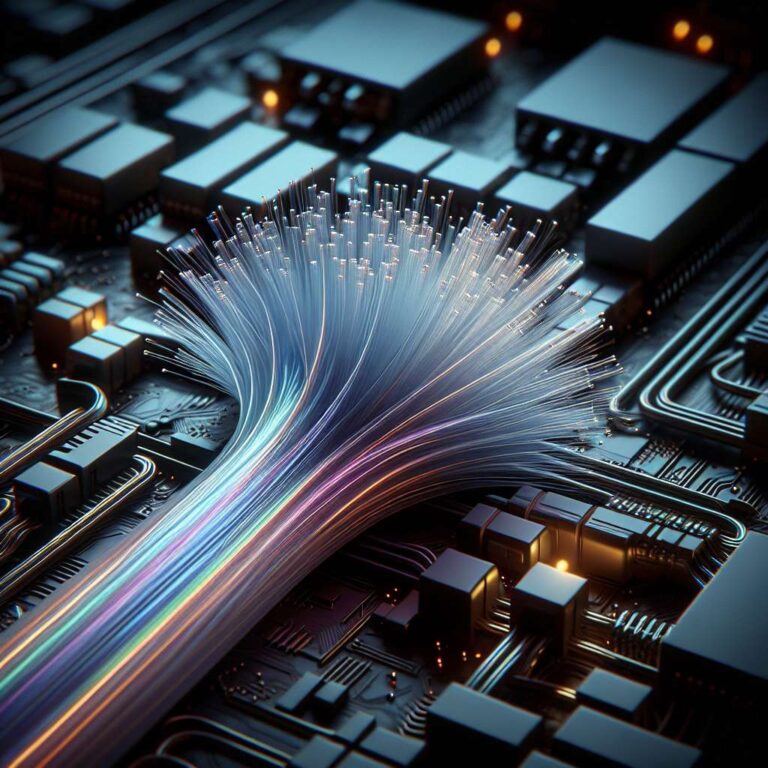
Lightmatter announced a world-first demonstration of a 16-wavelength bidirectional Dense Wavelength Division Multiplexing optical link running on a single strand of standard single-mode fiber. The company credits its ´Passage´ interconnect and ´Guide´ laser technologies for enabling the dense spectral packing and bidirectional operation. The result is a compact fiber footprint with higher spectral utilization than typical point-to-point implementations.
Technically, the link provides 800 Gbps of bidirectional bandwidth per fiber, split as 400 Gbps transmit and 400 Gbps receive, and is intended to work over distances of several hundred meters or more. That aggregate capacity comes from multiplexing 16 wavelengths on one fiber while maintaining separate upstream and downstream channels on the same strand. Lightmatter positions the approach as a step beyond current co-packaged optics offerings by raising both radix and bandwidth per fiber, which addresses two key constraints in modern data center interconnect design.
The announcement is framed against the backdrop of growing demand from trillion-parameter mixture of experts models and other large-scale Artificial Intelligence workloads. Those models push network fabrics for higher throughput and more ports, creating pressure on chip I/O and rack-level interconnects. By increasing wavelength density and enabling bidirectional traffic on one physical fiber, the technology aims to reduce fiber count and port requirements while preserving or increasing usable capacity.
Beyond raw throughput, Lightmatter emphasizes spectral efficiency and system resilience as benefits of the demonstration. Fewer fibers and higher per-fiber capacity can simplify cabling, lower space consumption in optical pathways, and change trade-offs for chip and module designers. The company did not announce commercial availability or deployment plans in the release, but the milestone sets a new data center interconnect benchmark and signals a trend toward tighter integration between photonic interconnects and compute hardware.