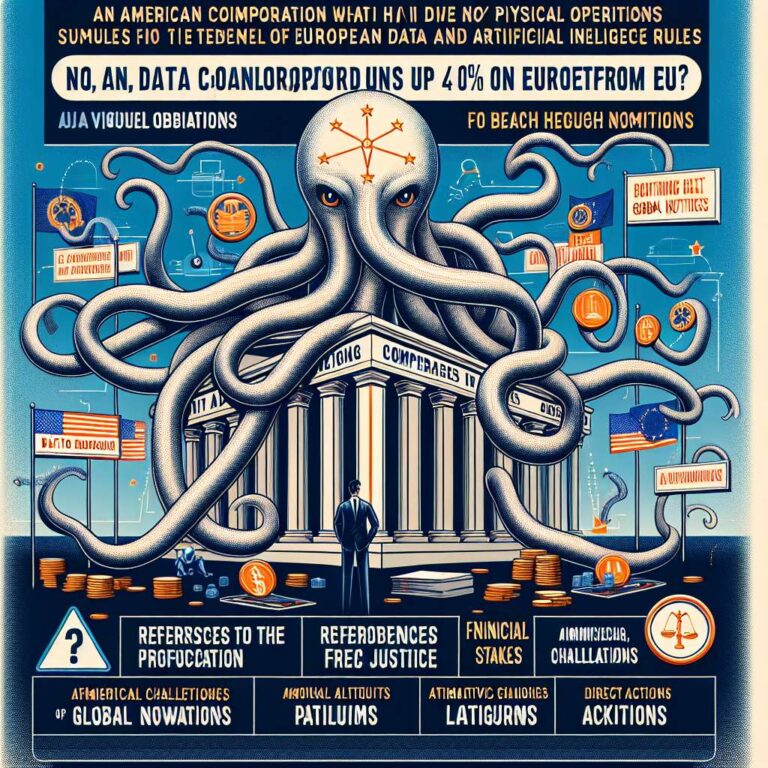
European data and Artificial Intelligence regulations increasingly reach beyond borders, raising sovereignty and commercial concerns for United States companies. The article highlights how public commentary, including testimony by a uk member of parliament before a US congressional committee, has drawn attention to perceived encroachment by European law. Regulators in the European union and the united kingdom can impose substantial penalties, cited as up to 4% of global annual turnover under the GDPR and up to 7% under the EU Artificial Intelligence Act, which amplifies the financial and operational stakes for companies without brick-and-mortar operations in Europe.
The article explains the GDPR’s territorial scope under Article 3, which applies to processing in the context of an establishment in the European union and to non-EU controllers that offer goods or services to EU residents or monitor their behavior. Article 3(3) further captures controllers operating “in a place where member state law applies by virtue of public international law.” Practical consequences for American enterprises include the Article 27 obligation to designate an EU representative, compliance with cross-border transfer mechanisms such as standard contractual clauses, binding corporate rules, or an adequacy decision, and scrutiny in light of court decisions like Schrems II. Once within scope, companies may face EU supervisory authority investigations, obligations to maintain EU-style records, data subject rights processes, breach notifications, and fines up to 4% of global turnover. The piece also notes a separate post-Brexit version of the GDPR in the united kingdom.
The EU Artificial Intelligence Act likewise uses broad territorial rules under Article 2 to capture providers and deployers whose outputs are used in the union. The article gives the example of a Texas software company whose resume-screening tool is used by a single employer in France and who would need to comply with risk classification, conformity assessments, technical documentation, post-market monitoring, and human oversight requirements. To challenge perceived overreach, the authors set out legal avenues: preliminary references by national courts to the Court of Justice of the EU, administrative challenges where a company requests an exemption and then litigates a refusal, national-court challenges to implementing measures, and direct actions under Article 263 TFEU against delegated or implementing acts. The article warns that compliance costs can deter start-ups from European expansion and that careful legal strategy is required to raise constitutional and ultra vires arguments before EU courts.