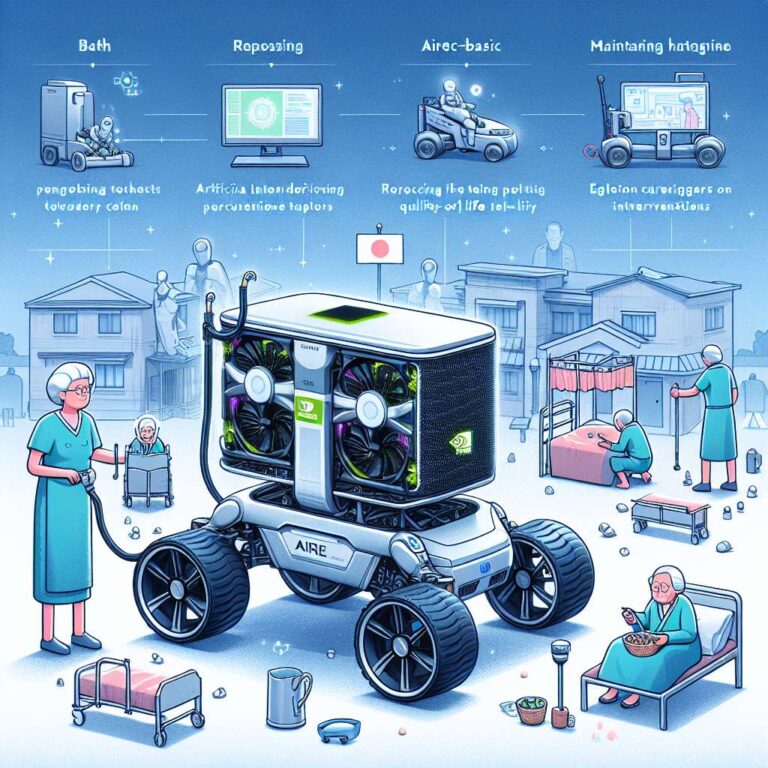
The Moonshot research program, funded by the Japan Science and Technology Agency, is working to create a world by 2050 where Artificial Intelligence powered, autonomously learning robots are integrated into Japanese citizens’ everyday lives. This initiative is one of 10 ambitious technology goals within the broader Moonshot program, which spans fields from ultra-early disease prediction to sustainable resource circulation. In response to Japan’s rapidly aging population, many of the current Moonshot research projects focus on how robots can support senior care, including designing machines capable of caregiving tasks such as cooking, cleaning and hygiene care.
NVIDIA technologies sit at the core of the program’s senior care platform, known as AI-Driven Robot for Embrace and Care, or AIREC. The larger and more mobile Dry-AIREC robot carries two NVIDIA GPUs onboard to handle complex perception and control workloads in real time, while the AIREC-Basic system, which is primarily used for collecting data to train a motion foundation model, relies on three NVIDIA Jetson Orin NX modules for Artificial Intelligence processing at the edge. The research teams also use NVIDIA Isaac Sim, an open-source robotic simulation framework, to train AIREC robots on specific tasks such as estimating forces between objects, accelerating development timelines from concept to practical prototypes. Researchers say the rapid recent advances in generative Artificial Intelligence have shifted perceptions, making such applications appear realistically achievable rather than speculative.
Academic teams across Japan are now building out AIREC’s full set of caregiving capabilities. Projects led by researchers at the University of Tokyo focus on essential actions such as changing diapers, assisting with bathing and providing meal support so that robots can take on physically demanding routines while human caregivers concentrate on improving patients’ overall quality of life. A recent study presented at the IEEE/RSJ International Conference on Intelligent Robots and Systems targeted the complex challenge of safely repositioning patients to prevent bed sores and enable diaper changing. To train Dry-AIREC for this work, the team used laptops powered by NVIDIA RTX GPUs, combined with 3D posture estimation, trajectory calculations and force estimation, along with data from fisheye and depth cameras to infer the necessary movements. The robot predicts pressure needed at the shoulders and knees and times its motions to achieve the required repositioning force without causing pain. Initial experiments on mannequins have progressed to tests involving human subjects, with ongoing work to refine safety and reliability. Researchers involved in goal No. 3 of Moonshot emphasize the social and personal importance of elderly care robotics and plan to showcase their latest progress at the 2026 International Symposium on System Integration in January.