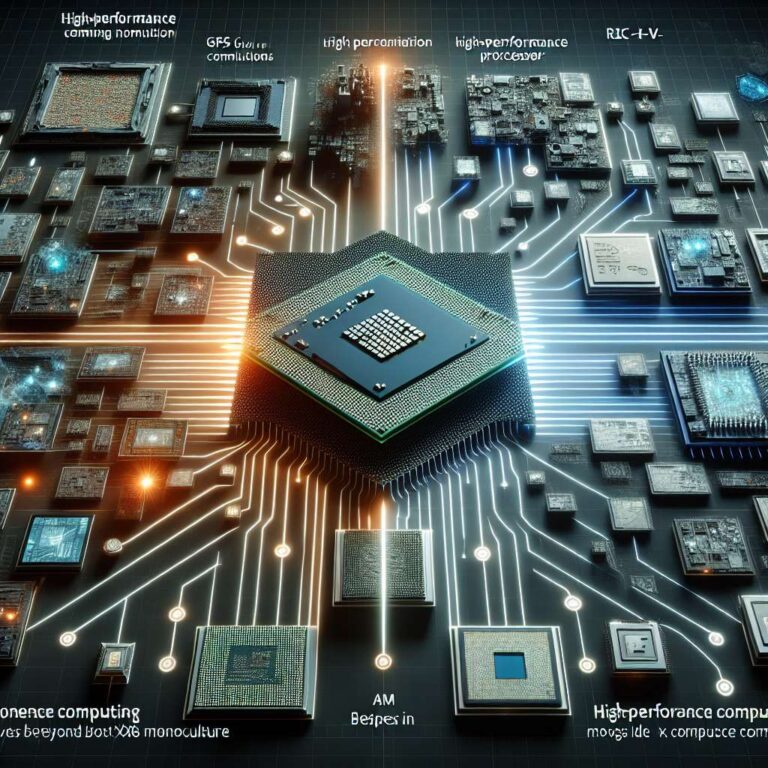
High-performance computing has shifted from a near-monoculture of x86 to a more diverse ecosystem. Exactly a decade ago almost nine in ten supercomputers in the TOP500 were Intel-based; today that figure is 57 percent. The emergence of GPUs, pioneered for general compute by Nvidia’s 2006 CUDA launch, delivered dramatic speedups for parallel workloads and has driven architects to rethink the role of the CPU versus accelerators.
CPUs remain essential for scalar work such as job scheduling, workflow management and certain reductions that do not parallelize well. The article traces the history from Cray vector machines through RISC families to Intel’s commodity-cluster dominance after NASA’s 1994 Beowulf work and the 1997 ASCI Red deployment using 9,152 Pentium Pro processors. Later examples such as Oak Ridge’s 2012 Titan, which paired AMD Opterons with Nvidia K20 GPUs across 18,688 nodes for 17.6 petaflops, show how CPU and GPU pairings became the standard. Nvidia’s tightly integrated hardware and software stack remains a powerful advantage, but AMD has made notable gains with its EPYC CPUs and Instinct GPUs, powering Frontier in 2023 with 9,472 CPUs and 37,888 GPUs and helping El Capitan retain a top spot.
Arm’s route from mobile to exascale has been patient but consequential. Projects such as Mont-Blanc and Fugaku showcased Arm in HPC, and Nvidia’s Grace and the Grace Hopper superchip, supported by over 40 announced supercomputer projects and used in systems like Bristol’s Isambard-AI with more than 5,500 Grace Hopper nodes, underline Arm’s viability. Benchmarking in 2023 reported energy savings of around 25-30 percent for Arm versus comparable x86 chips on Artificial Intelligence workloads. Meanwhile RISC-V offers an open instruction set with no licensing fees and has attracted European initiatives. The European Processor Initiative taped out functional RISC-V accelerator test chips in 2021 and its successor DARE carries a €240 million budget and aims for a full European hardware/software stack within three years.
The article concludes that HPC is moving back toward architectural diversity. Hyperscalers and custom silicon projects – from bespoke ASICs like Maia, Inferentia, Trainium and TPU to wafer-scale engines and silicon photonics – demonstrate a wide range of viable approaches. With so much investment and momentum behind alternatives, it is unlikely that x86 will remain the sole dominant architecture in the long term.