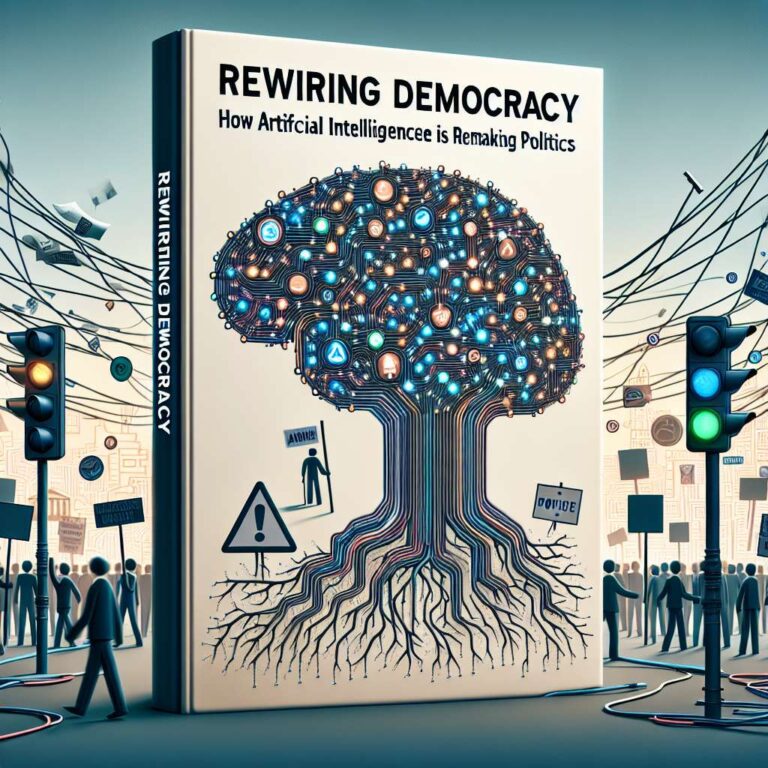
The article is an excerpted review of Rewiring Democracy: How Artificial Intelligence Will Transform Our Politics, Government, and Citizenship by cybersecurity technologist Bruce Schneier and data scientist Nathan E. Sanders, published by MIT Press in 2025. The review opens with a provocative example from 2024, when a Cheyenne, Wyoming, mayoral candidate pledged to outsource all decisions to an Artificial Intelligence system if elected, and the candidate ultimately came in a distant fourth, earning only 3 percent of the vote. This failed bid is presented as a dystopian but illustrative data point in a broader story about how rapidly developing Artificial Intelligence tools are exerting an outsize influence on politics and public life.
The reviewer explains that while voters may already be familiar with older campaign technologies such as autopen and robocalls, the new wave of Artificial Intelligence systems now supports far more substantial political work. Legislators increasingly use Artificial Intelligence tools to email constituents, write speeches, draft messaging and bills, and solicit donations, embedding algorithmic assistance into the daily mechanics of representative government. Municipal governments deploy Artificial Intelligence to translate public meetings for non English speakers and optimize traffic signals to reduce congestion, the military uses Artificial Intelligence to track moving personnel and resources, and judges rely on it to help draft rulings, underscoring that the technology is already deeply embedded in core state functions.
Schneier and Sanders argue that because Artificial Intelligence is here to stay, liberal democracies must focus on harnessing it for public benefit rather than resisting its adoption. The book is described as optimistic about how politicians can integrate these systems so government becomes more accessible and responsive to citizens. At the same time, the authors acknowledge serious concerns, including what the review characterizes as a reckless, aggressive push for Artificial Intelligence by the second Trump administration, but they largely avoid an alarmist tone. The reviewer, however, wishes the book probed more deeply into whether certain tasks should be delegated to technology at all, rather than only whether they can be, and finds the idea of Artificial Intelligence replacing some forms of journalism particularly distasteful. Ultimately, the reviewer writes that the book did not persuade them that embracing Artificial Intelligence will make government more responsive to actual humans, but still calls it a thought provoking, succinct and timely exploration, urging readers to engage with it directly and to avoid outsourcing their own conclusions to an Artificial Intelligence agent.