
How Artificial Intelligence Can Elevate Human Creativity

Artificial Intelligence is redefining artistic processes, offering fresh possibilities and challenges for creators.

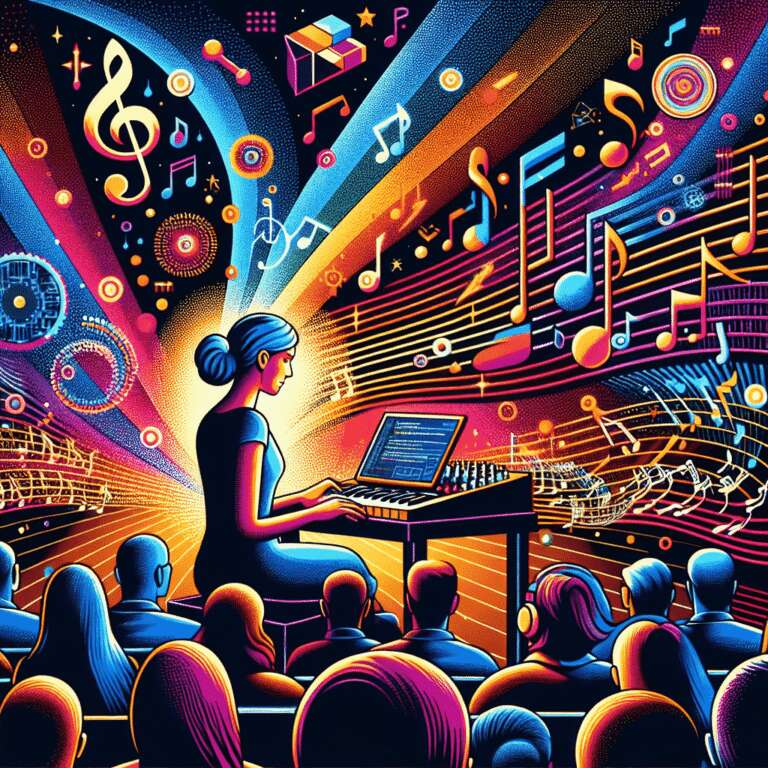
Lizzie Wilson, a live coder, demonstrates the intersection of Artificial Intelligence and creativity by incorporating AI-driven generative models in her electronic music performances. This art form, known as algorave, uses real-time coding to create music, providing a unique and interactive experience for audiences. Wilson leverages a live-coding agent—a type of generative AI—that introduces unpredictable beats and loops to her music, pushing creative boundaries.

The concept of co-creativity, or more-than-human creativity, is being explored by researchers like Wilson and institutions such as the Creative Computing Institute. Artificial Intelligence tools are being developed to inspire human creativity, offering new mediums and helping artists produce work that might not have been possible independently. While generative models from tech giants like OpenAI and Google DeepMind offer automated creative outputs, they differ in that they aim to supplement rather than supplant human creativity.

However, the rapid adoption of generative tools raises concerns over their impact on human creative development. Critics argue that while these tools democratize access to creative processes, they potentially stifle independent creativity and problem-solving skills. Concerns are akin to those expressed by Microsoft´s research team, which warns against over-dependence on such tools. Nevertheless, some artists and researchers see potential in these technologies to enhance creative practices by introducing elements of surprise and pushing creators into new directions, analogous to how artists have historically transformed technology into art.
65

Impact Score

Report finds California creative job losses are not driven by Artificial Intelligence

New research from Otis College of Art and Design finds California’s recent creative industry job losses stem from cost pressures and structural shifts, not direct worker displacement by generative Artificial Intelligence. The technology is changing workflows and expectations, but it is largely replacing tasks rather than entire jobs.

U.S. senators propose broader chip tool export ban for Chinese firms

A bipartisan proposal in the U.S. Senate would shift semiconductor equipment controls from specific fabs to targeted Chinese companies and their affiliates. The measure is aimed at cutting off access to advanced lithography and other wafer fabrication tools for firms such as Huawei, SMIC, YMTC, CXMT, and Hua Hong.

Trump executive order targets state Artificial Intelligence laws

Executive Order 14365 lays out a federal strategy to discourage, challenge, and potentially preempt state Artificial Intelligence laws viewed as burdensome. Employers are advised to keep complying with current state and local rules while preparing for regulatory uncertainty in 2026.

Who decides how America uses Artificial Intelligence in war

Stanford experts are divided over how the United States should govern Artificial Intelligence in defense, surveillance, and warfare. Their views converge on one point: decisions with such high stakes cannot be left to companies alone.

GPUBreach bypasses IOMMU on GDDR6-based NVIDIA GPUs

Researchers from the University of Toronto describe GPUBreach, a rowhammer attack against GDDR6-based NVIDIA GPUs that can bypass IOMMU protections. The technique enables CPU-side privilege escalation by abusing trusted GPU driver behavior on the host system.

Contact Us

Got questions? Use the form to contact us.

Contact Form

Clicking next sends a verification code to your email. After verifying, you can enter your message.