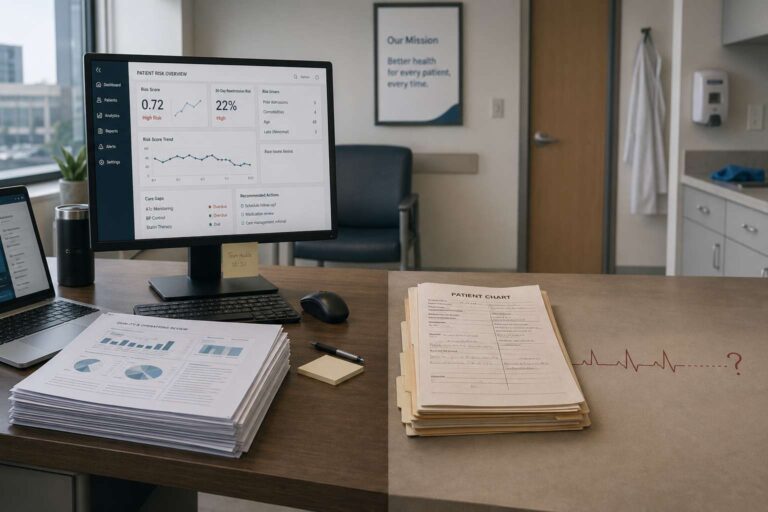
Artificial Intelligence is becoming increasingly common in hospitals. Doctors are using it for notetaking, systems are scanning patient records to flag people who may need support or treatment, and other tools are interpreting medical exam results and X-rays. A growing body of research suggests many of these systems can produce accurate results, but a more consequential question remains unresolved: whether their use actually leads to better health outcomes for patients.
Jenna Wiens of the University of Michigan and Anna Goldenberg of the University of Toronto argue in Nature Medicine that health-care providers are moving quickly to deploy these technologies without rigorously assessing their real-world effects. Wiens says interest from clinicians has shifted dramatically in recent years, with providers now far more willing to adopt these systems. That growth is especially visible in “ambient Artificial Intelligence” tools, or Artificial Intelligence scribes, which listen to doctor-patient conversations and generate transcripts and summaries. These products are already being widely adopted, and early studies suggest they can reduce clinician burnout and improve provider satisfaction.
Even so, evidence on patient benefit is still thin. Researchers have examined provider and patient satisfaction, but they have not really determined how these tools affect clinical decision-making. The same concern applies to predictive systems and treatment recommendation tools that are meant to make care more effective and efficient. Even a system that is accurate may not improve outcomes, because its impact depends on how doctors use it, how it changes interactions with patients, and how it influences treatment decisions. Those effects may differ across hospitals, departments, workflows, and levels of clinical experience.
Wiens also raises concerns about unintended consequences. Research in education suggests that Artificial Intelligence tools can alter how people cognitively process information, raising questions about whether scribes could change how doctors or medical students interpret patient data. In a study published in January 2025, Paige Nong at the University of Minnesota and her colleagues found that around 65% of US hospitals used Artificial Intelligence-assisted predictive tools. Only two-thirds of those hospitals evaluated their accuracy. Even fewer assessed them for bias.
Wiens does not argue for halting adoption. She says the priority is stronger evaluation by hospitals and other independent entities to determine how well these systems help in specific settings. Some tools could leave patients worse off, though she suggests it is more likely that many simply do less good than providers assume. The likely future for health care, in her view, is neither all Artificial Intelligence nor no Artificial Intelligence, but a more carefully tested middle ground.