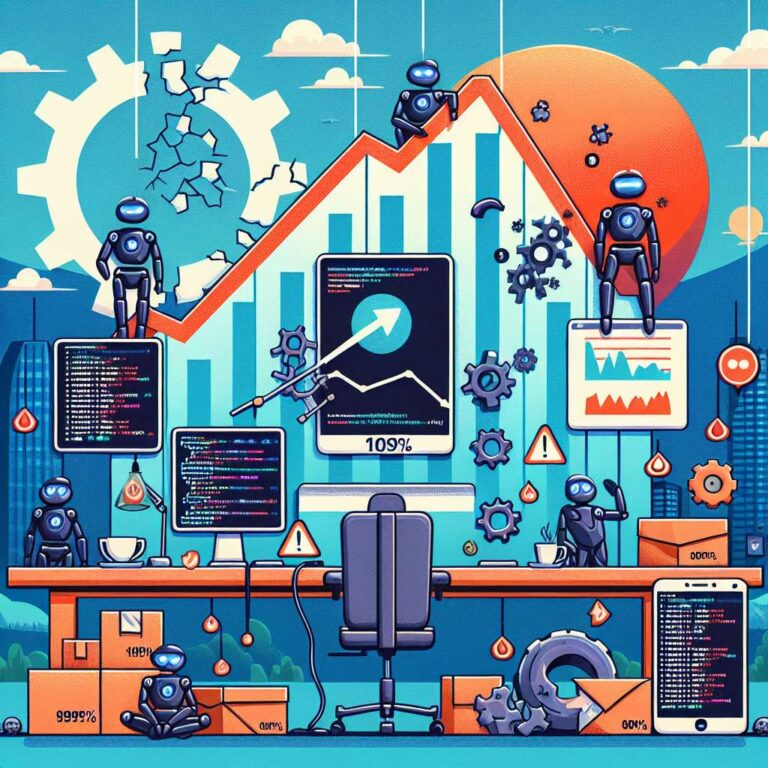
GitHub is facing renewed scrutiny over whether it still merits status as the top git platform for Artificial Intelligence-native development. Poor availability has persisted for months, with concerns that the platform is struggling to handle increased traffic from Artificial Intelligence coding agents. Questions are also building around leadership and focus, as the company has no CEO and appears to lack clear direction at a time when developer expectations are shifting quickly.
Reliability has become the central issue. Highly reliable systems usually target four-nines of availability (99.99%, meaning about 52 minutes of downtime per year), and barely hitting three nines (around 9 hours of downtime per year) is generally seen as poor performance. In the past month, GitHub’s reliability is down to one nine (~90% – !!). The situation is serious enough that attention has shifted to a third-party “missing GitHub status page,” created after GitHub stopped updating its own status page due to terrible availability.
Developer tooling practices are also drawing criticism. Claude Code and GitHub Copilot auto-add themselves to commits and pull requests, a behavior framed as effectively free advertising for the tools. Codex and OpenCode intentionally do not. The contrast highlights a broader debate about how much visibility coding assistants should claim inside software development workflows, especially as these products become more deeply embedded in daily engineering work.
Elsewhere in the industry, Microsoft is promising that Windows will not remain associated with the “Microslop” label after years of unpopular choices such as forced Copilot integrations, Start menu ads, and mandatory Microsoft accounts. The wider ecosystem is also dealing with a massive LLM supply chain attack via LiteLLM, backlash after Cursor failed to mention that Composer 2 is based on an open source model, discussion about what happens when teams stop reviewing Artificial Intelligence-generated code, and OpenAI’s decision to kill Sora. Taken together, these developments point to growing strain across platforms that are trying to define the next phase of Artificial Intelligence-assisted software development.