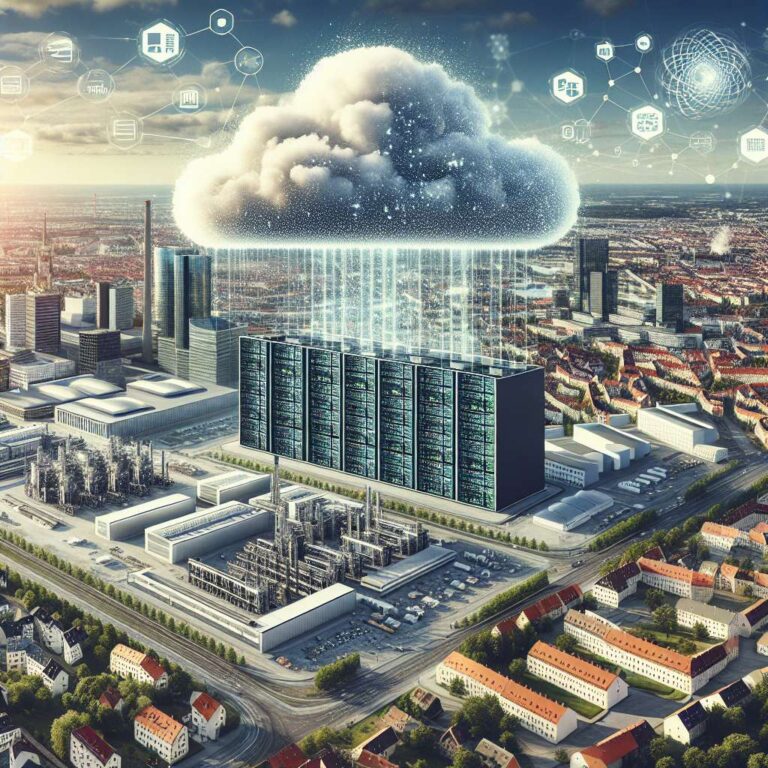
Germany is stepping up its industrial artificial intelligence strategy with the launch of the Industrial AI Cloud in Munich, a high performance computing project backed by Deutsche Telekom that is intended to reduce dependence on US providers and strengthen European technological sovereignty. The facility was planned, built and launched in just six months, compared with the typical 12 to 24 months, by repurposing and modernizing an existing data center in Munich’s Tucherpark. Equipped with nearly 10,000 NVIDIA Blackwell GPUs, Telekom says the computing power is sufficient for all 450 million EU citizens using an artificial intelligence assistant simultaneously, although the cloud is aimed primarily at industrial users rather than consumers.
The focus is on manufacturing-centric artificial intelligence applications aligned with Germany’s strengths in automaking, machinery and robotics, rather than on consumer platforms dominated by the United States and China. Industrial artificial intelligence models are expected to tap into more than a decade of highly specialized production, logistics and machine-level data from Germany’s small and medium enterprises, the Mittelstand, which are widely seen as the backbone of the economy. Policymakers and researchers are positioning this approach as “trustworthy artificial intelligence,” arguing that the EU’s artificial intelligence Act can become a competitive advantage by giving firms clear, enforceable rules for deploying safe and reliable systems. Siemens is expanding its partnership with NVIDIA to build an Industrial artificial intelligence Operating System and embed assistants into factory automation platforms, while Bosch is spending $2.9 billion (€2.4 billion) to roll out artificial intelligence based quality control technologies. Germany’s Economy Ministry projects that widespread artificial intelligence adoption in industry could add at least one percentage point to annual real GDP growth starting this year.
Chancellor Friedrich Merz is backing the push through the High-Tech Agenda, which promises €18 billion in funding before 2029 and prioritizes artificial intelligence among six strategic technologies including quantum computing, microelectronics, biotech, fusion and climate-neutral mobility. At the same time, business culture and risk aversion are seen as major obstacles, with executives often keeping artificial intelligence projects in pilot mode and seeking perfection before rollout, in contrast to faster iteration in China and the United States. Experts say truly transformative industrial artificial intelligence will depend on models that deliver causal insights for complex supply chain and production decisions, something industry watchers estimate could be up to five years away. The strategy also unfolds as German manufacturers lose ground to China, with German exports to China slipping to €81.8 billion ($97.2 billion) in 2025, their lowest level in a decade, and auto exports falling by 66% from a 2022 peak. Although the Industrial AI Cloud is already running at more than a third of its capacity and attracting firms like Agile Robots and PhysicsX, researchers warn that industrial production is likely to lose its central role in the economy within the next five to 10 years, and argue that Germany must gradually transform into a service economy built on digital services.