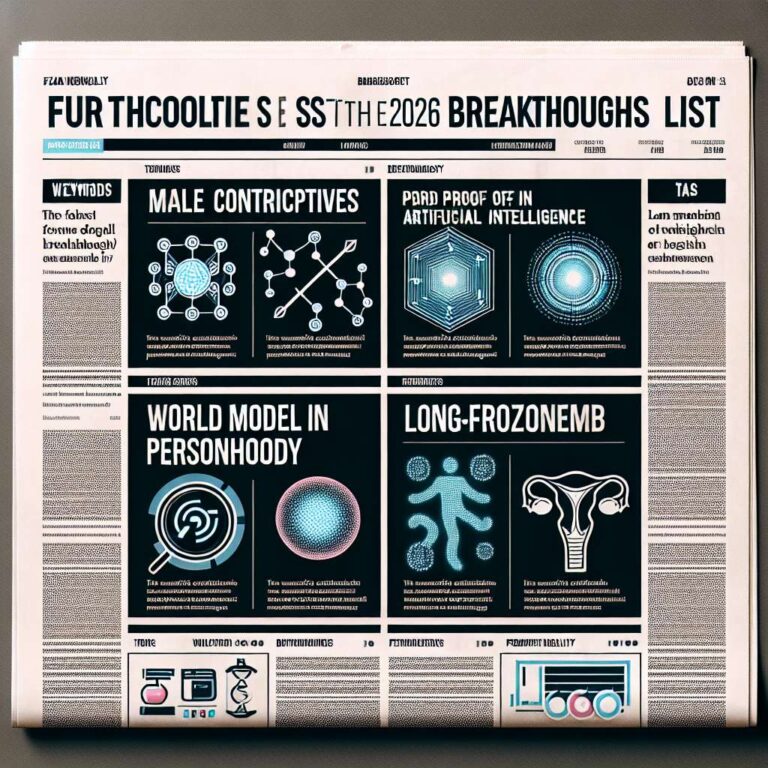
Each year the newsroom selects 10 breakthroughs that it expects will help define the future. The editors review and debate dozens of ideas, weighing potential impact, similarity to past selections, and confidence that a recent advance will become a lasting success. The 2026 list will appear on January 12, and the following technologies were closely considered but did not make the cut.
First, new male contraceptives are moving through development but remain years away from wide availability. Several treatments are in the pipeline, including two being tested in clinical trials by Contraline: a gel men would rub on their shoulder or upper arm once a day to suppress sperm production, and a device designed to block sperm during ejaculation. A once-a-day pill is also in early-stage trials with YourChoice Therapeutics. The story noted Kevin Eisenfrats, Contraline’s CEO, was recently named to our Innovators Under 35 list. Despite promising progress, the editors judged these approaches unlikely to clear clinical testing and regulatory barriers quickly enough to count as a 2026 breakthrough.
Second, world models are emerging as a hot area in Artificial Intelligence. Trained on videos or spatial data, these systems aim to produce 3D virtual worlds from simple prompts and to capture physical principles such as gravity. Potential applications include game design and improving robot understanding of physical surroundings. Renowned researchers including Yann LeCun and Fei-Fei Li have launched companies to pursue world models; Li’s startup World Labs released its first version last month and Google released its Genie 3 world model earlier this year. Editors saw the field gaining momentum but felt it was premature to label world models a breakthrough for 2026.
Third, proof of personhood gained attention as Artificial Intelligence makes it harder to distinguish humans from synthetic content. Proposals include cryptographic tokens tied to in-person identity checks so a device can verify a user when performing sensitive actions, such as logging into a bank account. Efforts by OpenAI, Microsoft, Harvard, and MIT were described alongside competing projects such as World ID by Sam Altman’s startup Tools for Humanity. The newsroom concluded the idea is important but still fragmented across competing approaches and standards.
Finally, a record-setting infant developed from an embryo stored for more than 30 years highlighted changes in IVF practice and embryo adoption. The birth was enabled by safer thawing methods and the growth of agencies that match donors and parents willing to use long-stored embryos. Editors noted this achievement reflects shifting norms as much as a single technological breakthrough, so it did not meet their criteria for the 2026 list.