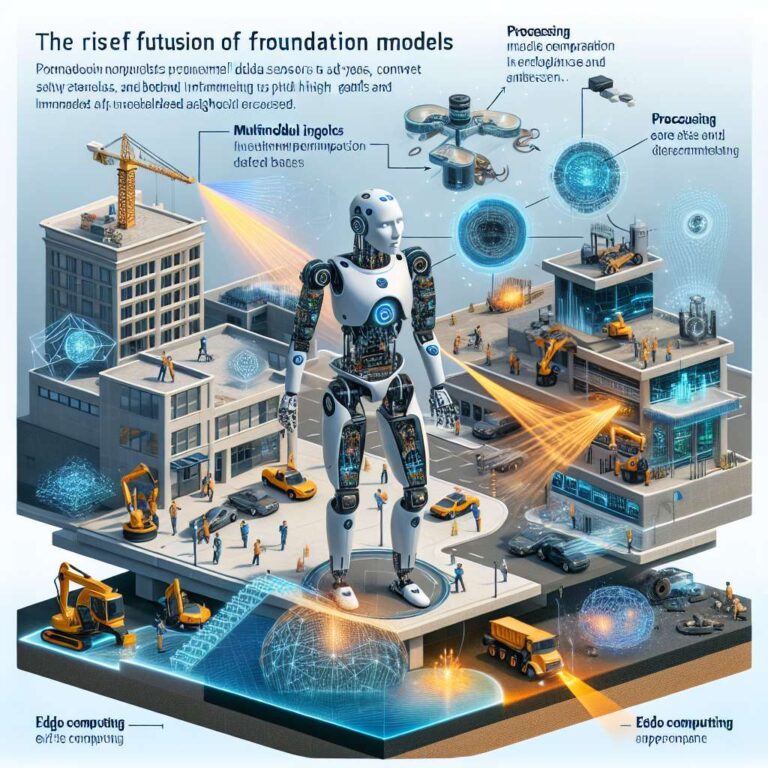
Physical artificial intelligence, or embodied artificial intelligence, is emerging as the next phase of autonomous systems by bringing machine intelligence into direct interaction with the physical world. The shift is visible from self-driving vehicles in the US to cobots in construction, warehousing, and manufacturing, and even to humanoid robots and advanced healthcare devices. Executives from Nvidia, Boston Dynamics, Bedrock Robotics, and Voxel51 describe a transition away from robotics defined by hardware toward robots whose real breakthrough lies in new classes of foundation models tailored for perception, world modeling, and control under real-world constraints. These models must handle messy, unexpected environments, from children’s birthday parties on highway medians to trucks struck by lightning, while maintaining safety and reliability.
Several model families underpin this new generation of physical artificial intelligence. Large behavior models learn from extensive human demonstrations rather than explicit task programming, enabling whole-body coordination, obstacle avoidance, balance, and delicate manual work using techniques such as action-chunking to stay responsive to disturbances. Vision language action foundation models, such as Nvidia’s Isaac GR00T N, translate multimodal sensor input and natural language commands into goals and high-level plans, then must be paired with low-level motor controllers to achieve real-time execution. Open world models like Nvidia Alpamayo 1 and Nvidia Cosmos learn environment dynamics by jointly ingesting sensors such as cameras, radar, lidar, and ultrasonics to support planning, simulation, and in-vehicle perception and reasoning, although their computational cost makes production deployment challenging without optimizations such as skip-training in diffusion or prediction in latent spaces.
Generative policies, including diffusion-style policies, are gaining traction as denoising mechanisms that help robots cope with the vast range of possible actions and the noisy signals they receive, providing more robust handling of uncertainty than single-shot predictors. Experts debate whether specialized, domain-specific models or larger generalist models are better suited to edge deployment, given tight control loops and the impracticality of streaming massive sensor datasets to the cloud in real time. Across domains such as automotive, healthcare, factories, and warehouses, leaders stress the need for full-stack accelerated platforms that connect artificial intelligence supercomputing for pre-training and simulation with high-performance, low-latency inference at the edge, since collision-critical decisions cannot depend on internet latency. The near-term roadmap for physical artificial intelligence involves building high-fidelity digital twins and simulation pipelines, scaling synthetic data, and progressing through human-supervised deployments to fleet-scale systems, with expectations that over the next two to three years physical artificial intelligence models will expand significantly in capability, adaptability, and real-world usefulness.