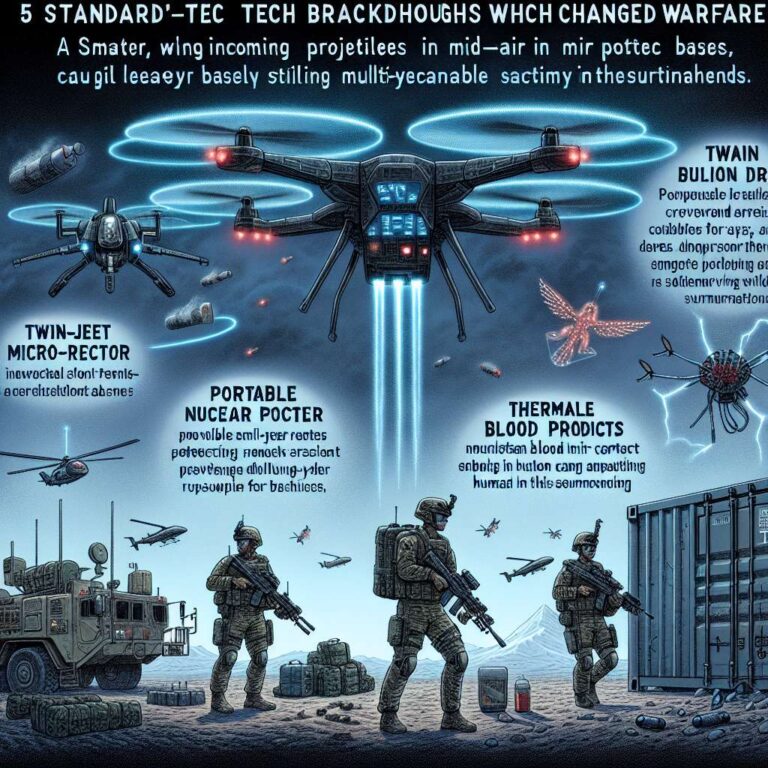
The article argues that 2025 marked a turning point for military technology, moving beyond overhyped promises and cumbersome gear into systems that feel taken from science fiction. Instead of heavier radios and complex interfaces, forces are now fielding operational laser weapons, reusable loitering munitions, portable nuclear reactors, synthetic blood products, and adaptive thermal camouflage. Together, these technologies are reshaping how armies protect bases, supply front lines, treat casualties, and evade detection, while making the battlefield more lethal and less forgiving for the people operating them.
The first breakthrough is Rafael’s Iron Beam, a high-energy laser air defense system that became officially operational in late 2025. It replaces traditional interceptor missiles with a 100kW laser that superheats incoming threats in mid-air, leaving no explosion or exhaust trail and eliminating reload times. Instead of firing a $50,000 interceptor missile to knock down a $500 enemy mortar, the Iron Beam uses a 100kW high-energy laser to bake the threat in mid-air like a potato. The cost per engagement drops dramatically, as the cost per shot is roughly $3, enabling what the author describes as a “laser wall” that can make saturation attacks economically untenable.
The second highlighted system is Anduril’s Roadrunner, a twin-jet autonomous vehicle that can launch quickly, loiter at high subsonic speeds, and autonomously classify potential targets. It was already operationally hunting by late 2025 and is designed to address the so-called “Patriot Problem,” where commanders are reluctant to fire a $4 million missile at cheap drones. The Roadrunner can return and land vertically on its tail for reuse if no valid target is found, or convert itself into a warhead against threats like Shahed drones, effectively making it a reusable kamikaze platform with boomerang-like functionality.
The third major development is Project Pele, a Department of Defense effort to deploy portable nuclear microreactors. In December 2025, the Department of Defense reached a milestone with Project Pele, taking delivery of the first fuel for its portable nuclear microreactors. Unlike traditional nuclear power plants, these self-contained “nuclear batteries” fit inside standard shipping containers and are designed to power remote bases for years without fuel convoys. By eliminating the need to truck diesel through contested areas, they aim to remove one of the most vulnerable links in modern military logistics.
The fourth breakthrough focuses on synthetic and freeze-dried blood products often referred to as “vampire kits.” Trials for synthetic blood and “freeze-dried” plasma ramped up globally in 2025, with researchers receiving massive grants to finalize the “Nano-RBC” (Red Blood Cell). The envisioned product is a powder that mimics the oxygen-carrying capacity of real blood and can be stored for years at room temperature, then reconstituted with saline in the field. This would allow medics and infantry to carry life-saving blood substitutes in small kits without refrigeration, turning individual aid bags into what the author calls walking blood banks.
The final technology is adaptive thermal camouflage such as the HT4 system tested in Europe. Late in 2025, breakthroughs in adaptive thermal materials, like the HT4 system tested in Europe, introduced the magical idea of the “thermal invisibility cloak“. These materials can adjust to match the ambient temperature of surrounding terrain, masking a person’s or vehicle’s heat signature from thermal optics and drone sensors. The piece compares this capability to a real-life Harry Potter cloak and suggests it turns the tables on modern surveillance, making well-equipped soldiers far harder to detect.
In closing, the article cautions against viewing these developments as making war cleaner or simpler. Instead, it claims the reality of 2026 is a battlefield that has become “infinitely more unforgiving,” where 19-year-olds may control nuclear batteries and advanced drones while also facing enemies hidden by thermal cloaks and low-cost autonomous systems. The author argues this environment demands hyper-competent, technologically literate warfighters operating gear that is often smarter and faster than they are, but still dependent on a “filthy, sleep-deprived human” making irreducibly human decisions under pressure. Despite the futuristic tools, the core requirement remains the same: adapt and overcome.