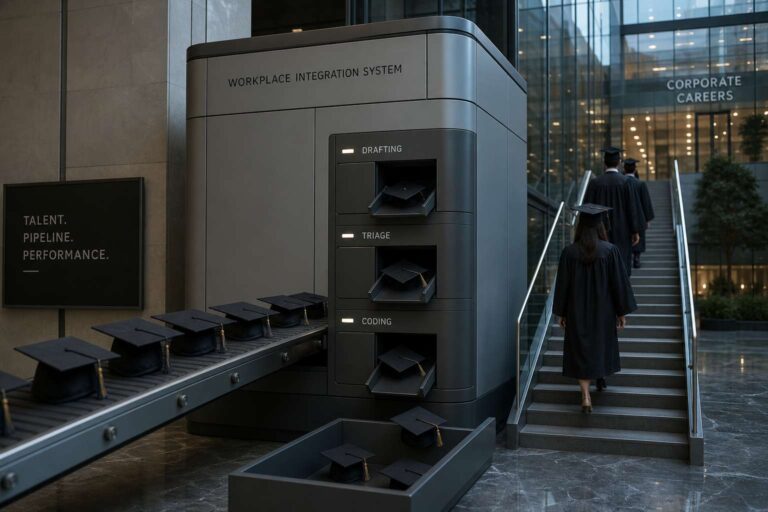
Aggregate employment in developed countries remains broadly stable, and recent assessments have found limited evidence that Artificial Intelligence has shifted the headline numbers. The sharper concern is emerging in early-career hiring, where the first signs of disruption are appearing. A working paper released in November 2025 by the Stanford Digital Economy Lab found that workers aged 22 to 25 in the most Artificial Intelligence-exposed occupations experienced a 16% relative decline in employment after the spread of generative Artificial Intelligence, even after controlling for other factors that might affect firms’ employment decisions. More experienced workers in those same occupations did not suffer the same decline, and employment is not also declining in the entry-level jobs with low Artificial Intelligence exposure.
The pattern suggests that firms may be using Artificial Intelligence to replace the junior tasks that traditionally help workers gain their first professional foothold, especially in roles where generative Artificial Intelligence is used extensively, like software developers, customer service representatives, computer programmers, and information systems managers. That risk is growing as the broader market for new graduates weakens. The Federal Reserve Bank of New York reported that in the fourth quarter of 2025, the unemployment rate for recent college graduates rose to 5.6%, while the underemployment rate reached 42.5%, its highest level since the covid pandemic. Artificial Intelligence may not be the sole cause, but it may be worsening an already difficult transition from school to work, with consequences that include prolonged job searches, financial stress, and delayed independence.
Entry-level jobs also function as a training system for the wider economy. Junior workers learn judgment, practical workflows, and how organizations operate under real constraints. If Artificial Intelligence absorbs more of the drafting, triage, coding, summarizing, and administrative preparation that once trained early-career workers, firms may gain efficiency in the short run while weakening the long-term development of skilled talent. That challenge undermines older advice centered on learning routine coding skills, because the kinds of standardized tasks that many training pipelines emphasized are now the same tasks that Artificial Intelligence handles well.
The proposed response is a broad redesign of how young people are prepared for work. Universities, community colleges, and professional programs should embed Artificial Intelligence literacy, data literacy, prompt-based workflow skills, verification skills, and domain judgment into standard degrees. Schools should expand paid co-ops, apprenticeships, and employer-linked projects so students gain workplace judgment before graduating. Governments should create targeted tax credits, wage subsidies, and training grants for employers that hire early-career workers into structured, Artificial Intelligence-augmented roles. Businesses are urged to treat entry-level hiring as an investment in future capability rather than a short-term cost, while students are encouraged to combine Artificial Intelligence fluency with domain expertise and human judgment.