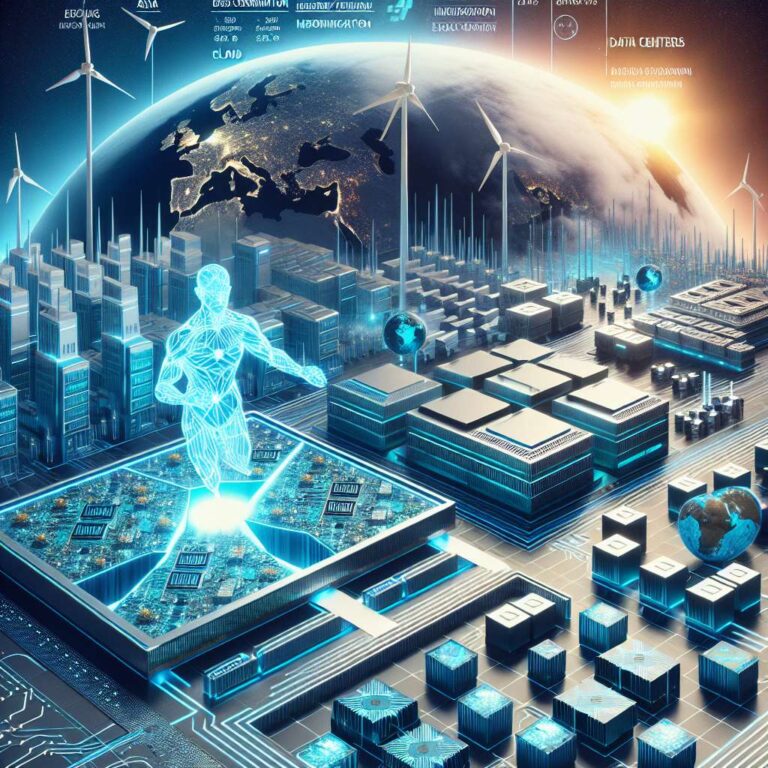
Across early March 2026, semiconductor and Artificial Intelligence infrastructure stories dominate, with companies from Taiwan, South Korea, Japan, China, Europe, and the US accelerating capital spending and product launches. Broadcom outlines aggressive Artificial Intelligence chip revenue targets tied to hyperscaler demand, while Samsung, SK Hynix, and other memory leaders move to capitalize on a DRAM supercycle and high-bandwidth memory needs. Foundry players including TSMC, Samsung, and Rapidus advance 2nm and advanced packaging roadmaps, backed by subsidies and localization pushes in Taiwan and Japan. Artificial Intelligence data centers emerge as a new battleground for power, cooling, and grid capacity, prompting Taiwan and other governments to weigh energy controls and new infrastructure.
Platform and device vendors race to embed Artificial Intelligence more deeply across PCs, smartphones, wearables, and automotive systems. Apple unveils M5 Pro and M5 Max processors with a renewed Artificial Intelligence focus for MacBook Pro and MacBook Air, refreshes Studio Display lines, and leans on loyalty strategies with new iPhone and iPad models and a reported ? MacBook Neo. Samsung expands Galaxy S26 Artificial Intelligence features and pushes a new phone to counter Apple’s embrace of Gemini Artificial Intelligence agents, while Qualcomm and MediaTek detail 6G, Wi-Fi 8, and Artificial Intelligence chip technologies at MWC 2026. Robotics and humanoid platforms gain momentum through deals such as Agility Robotics with Toyota, Tesla’s Optimus push, and multiple Chinese humanoid robot OEMs and models, as debates continue over the maturity of Artificial Intelligence humanoid robots.
Geopolitics and policy uncertainty thread through many of the developments, with US tariff rulings, Trump’s proposed 10% and 15% global tariffs, and countervailing duties on solar cells reshaping trade flows and raising concerns in Taiwan, Europe, and Asia. The US moves to bar federal purchases of China-linked chips and tightens scrutiny around semiconductor security and export controls, while India deepens its semiconductor and packaging ambitions through alliances with the US and Japan and projects such as Tata and HCL-Foxconn facilities. Artificial Intelligence sovereignty, Pentagon relationships with model providers, and Anthropic’s and OpenAI’s shifting safety and spending strategies feed a broader contest over who sets guardrails and who controls the next era of Artificial Intelligence infrastructure. Meanwhile, component shortages and price spikes in memory, glass fiber, inductors, capacitors, and PCB materials ripple through supply chains, reinforcing the leverage of key Asian suppliers and driving consolidation and strategic repositioning across the electronics industry.