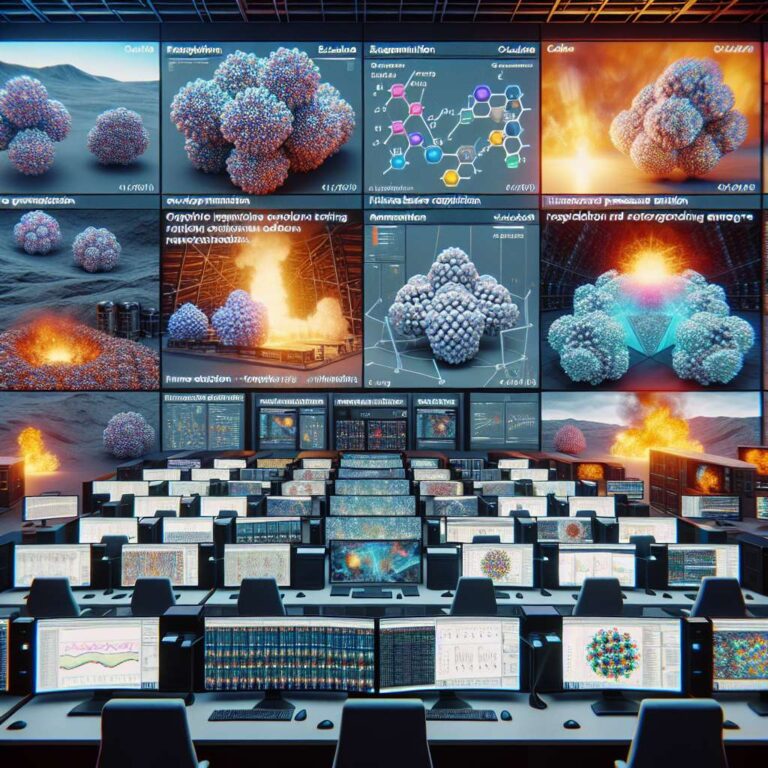
Researchers at Argonne National Laboratory and partner universities are studying how carbon behaves under extreme heat and pressure to better understand and direct the formation of nanocarbons. By combining physics, chemistry, supercomputers and Artificial Intelligence, the team is working to predict how carbon atoms rearrange themselves in explosive environments and to use those predictions to design new materials before they are made experimentally. The findings were published in the journal Carbon.
The work centers on nanodiamonds, tiny diamond crystals that form under explosive conditions. What happens as the material cools and pressure decreases determines whether the particles remain diamond or transform into other carbon structures, including layered sheets and hollow forms. Instead of relying only on costly and dangerous experiments, the researchers used Argonne’s Aurora supercomputer to simulate these changes atom by atom. They also used the Frontier supercomputer at DOE’s Oak Ridge National Laboratory. The Delta and DeltaAI systems at the National Center for Supercomputing Applications at the University of Illinois Urbana-Champaign were also used to perform some of the simulations of the carbon structures.
The simulations showed that the cooling path and pressure release strongly affect the final material. Rapid cooling tends to preserve the diamond form, while slower cooling allows carbon atoms to rearrange into layered shells and curved structures. The team then trained Artificial Intelligence models on the simulation data so the models could learn relationships between temperature, pressure and the resulting carbon shapes. That approach allows the computer to predict what type of nanocarbon will form under a given set of conditions, reducing dependence on lengthy trial-and-error work in the lab.
The ability to steer carbon into specific nanoscale forms could support a range of applications. Nanodiamonds may be useful in quantum sensors and medical imaging, while onion-like carbon particles are promising for electrical energy storage. Other small carbon forms that glow under light could be valuable in light-sensitive devices or biological imaging. Hollow carbon shells are especially attractive for carrying microscopic cargo into cells, which could make them useful for targeted medicine delivery.
The research also has implications for national security and industrial technologies that operate in high-energy environments. Better models of carbon under extreme conditions could improve understanding of explosives and protective materials, while also guiding the design of stronger coatings, lighter armor and more resilient components for harsh environments. The project highlights how physics-based modeling, large-scale computing and Artificial Intelligence can be combined into a practical materials design workflow.