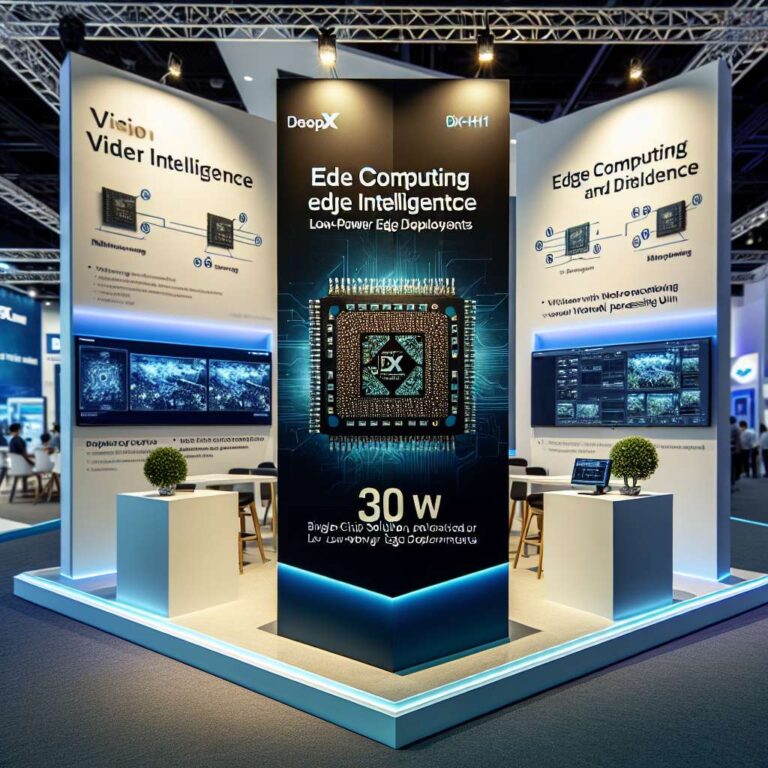
DEEPX announced the official launch of the DX-H1 vision neural processing unit (V-NPU) ahead of CES 2026. The company, described in the announcement as a pioneer in ultra-low-power on-device Artificial Intelligence semiconductors, positions the DX-H1 as a dedicated video intelligence chipset capable of processing hundreds of Artificial Intelligence video channels at just 30 W. The launch emphasizes a low-power approach to multi-channel video processing for edge deployments.
The DX-H1 V-NPU is presented as an all-in-one video intelligence solution that combines a multi-channel engine with a dedicated neural processing unit architecture. The multi-channel engine is capable of decoding, encoding and transcoding video streams, while the dedicated NPU is used for on-chip Artificial Intelligence inference. DEEPX describes the DX-H1 as handling the full processing stack on a single chip, from stream input to preprocessing, Artificial Intelligence inference, and re-encoding.
That single-chip approach is contrasted directly with traditional setups that require parallel configurations of GPU servers and hardware codecs. By integrating decoding, encoding, transcoding and NPU inference on one device, the DX-H1 reduces reliance on separate GPU servers and hardware codec chains for video pipelines. The announcement frames the product as a consolidated alternative for video AI workflows that traditionally span multiple pieces of hardware.
The public materials accompanying the announcement include imagery and links to additional coverage, and the company timed the unveiling to coincide with the run-up to CES 2026. The DX-H1 launch focuses on delivering multi-channel video handling and on-device Artificial Intelligence capabilities within a 30 W power envelope, highlighting DEEPX’s emphasis on ultra-low-power semiconductors for video intelligence applications.