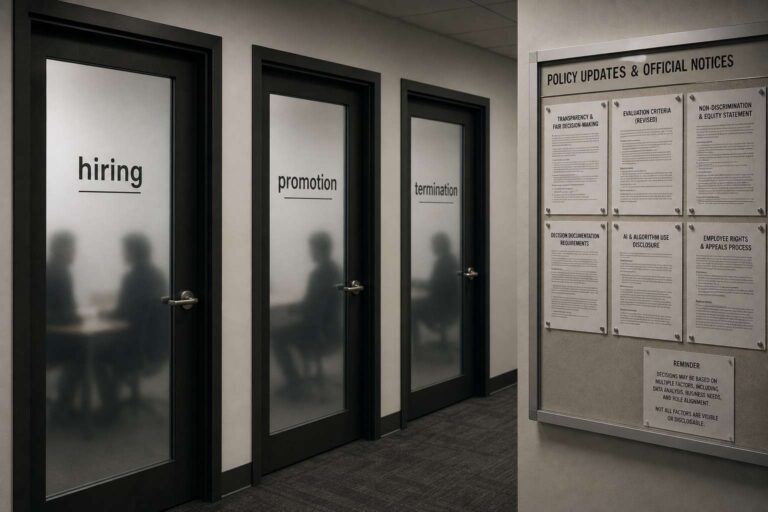
Colorado and Illinois are advancing employer-focused oversight of Artificial Intelligence in the workplace, signaling that state regulation is becoming more concrete rather than slowing down. Colorado has approved a comprehensive rewrite of its Artificial Intelligence law, while Illinois regulators are developing disclosure requirements aimed at employers that use Artificial Intelligence in employment decisions. The trend points toward more practical compliance obligations tied to hiring, promotion, discipline, termination, and other workplace decisions.
In Colorado, the revised approach is framed as a recalibration rather than a retreat. Employment uses remain in scope, and Artificial Intelligence tools used in hiring, promotion, and other employment decisions continue to be treated as high risk. Governance expectations also remain in place, meaning employers will still need risk management and oversight frameworks. Transparency obligations continue as well, with notice and documentation duties preserved even as specific requirements evolve. The overall direction is clearer rules, not reduced employer exposure.
Illinois offers a more detailed preview of how compliance may work in practice. Proposed regulations from the Illinois Department of Human Rights would require employers to notify applicants and employees when Artificial Intelligence is used in decisions such as hiring, promotion, discipline, or termination. Employers would also need to provide meaningful detail about the Artificial Intelligence tool used, the decisions it impacts, the types of data considered, and contact information for questions and accommodations. The proposal is now open for a 45-day public comment period.
Across both states, the emerging model emphasizes accountability, internal process design, and direct communication with workers. The same pattern is also appearing beyond Colorado and Illinois, with California, New York City, Texas, and others advancing overlapping requirements around disclosure, bias auditing, and employee notice, while states like Connecticut and Washington are developing similar frameworks. For employers, the issue is no longer whether regulation is coming, but how to build scalable compliance programs that can work across multiple jurisdictions.