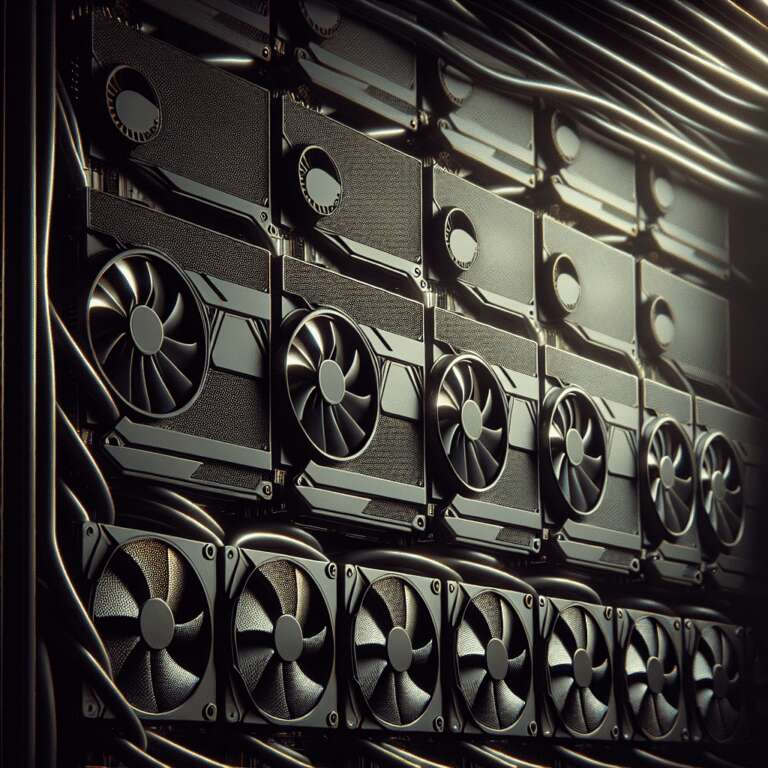
Chinese hardware companies and Artificial Intelligence researchers are customizing NVIDIA´s GeForce RTX 5090D ´Blackwell´ graphics cards to better address the specific needs of the local computing environment. Specifically created as a China-compliant variant to adhere to US export controls, the RTX 5090D has attracted attention among smaller research labs for its blend of power and versatility. To suit Artificial Intelligence server racks—which demand efficient, scalable thermal management—these custom cards forgo the usual gaming-focused cooling in favor of dual-slot blower-style designs that expel hot air directly out the chassis, aligning with rackwork requirements and facilitating dense deployments.
Innovators have gone beyond cooling overhaul, repositioning the power connector onto the rear bracket. This modification enables more efficient cable management and compact stacking in multi-GPU arrays—an essential consideration for Artificial Intelligence research clusters with space constraints. Technically, the cards maintain robust specs with 32 GB of advanced GDDR7 memory and a PCIe 5.0 x16 interface for high-bandwidth data transfer. However, the cards´ maximum power draw remains uncertain; while earlier ´D´ series cards peaked at 450 W, this Blackwell-based revision may reach up to 575 W, paralleling the standard RTX 5090. Although blower coolers tend to struggle at such high thermal design power (TDP), careful undervolting and underclocking could ensure operational stability over protracted workloads—a necessary compromise, given infrastructural limits.
These practical modifications arise in response to the acute GPU supply shortages impacting China’s Artificial Intelligence community. As research institutions and universities face mounting barriers in accessing advanced compute resources, transforming game-oriented GPUs into server-friendly, workstation-class units has become a vital strategy to democratize Artificial Intelligence acceleration. This trend underscores the resourcefulness of Chinese developers in navigating regulatory restrictions and market shortages, ensuring ongoing progress for smaller labs and academic teams chasing cutting-edge Artificial Intelligence development.