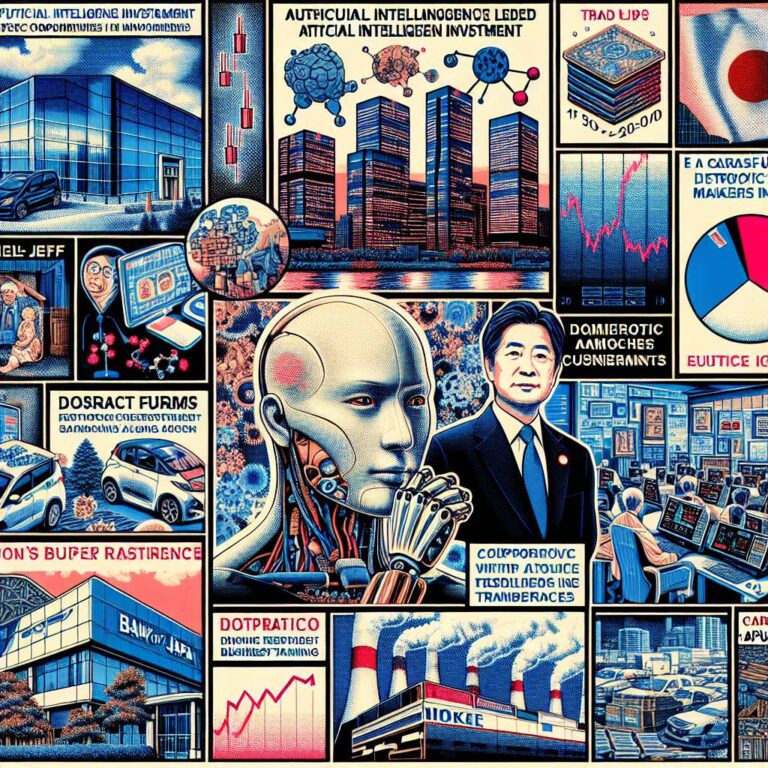
Recent business coverage from The Asahi Shimbun reveals a turbulent month for global markets, particularly as trade negotiations and technology trends shape strategies in Japan and beyond. Companies like SoftBank are rapidly investing in Artificial Intelligence infrastructure, with plans by year-end to build new data facilities in collaboration with OpenAI—aiming to deploy up to one billion Artificial Intelligence agents by 2026. However, a recent survey indicates that Japan lags behind the United States, China, and Germany in the use of generative Artificial Intelligence, underlining a national hesitancy to embrace these transformative tools at scale.
Trade remains at the forefront of business headlines. The United States and Japan have reached a 15% tariff agreement, sparking concern among Detroit-based automakers, who argue that such arrangements may put them at a disadvantage compared to their Japanese competitors. In contrast, Asian investor sentiment appears optimistic, with rising share prices buoyed by expectations of further trade pacts following the agreement. Major Japanese indices like the Nikkei have experienced significant gains, climbing as much as 3.5% in response to the new landscape created by U.S. policy announcements and ongoing negotiations.
Beyond the headline-grabbing topics of Artificial Intelligence and trade, Japan’s domestic economy is also in flux. Developments include Kansai Electric’s decision to build a new nuclear plant in Mihama, the transition of local transportation networks to electric buses, and resilience training initiatives led by firms like Duskin. Meanwhile, foreign investment dynamics continue to shift, highlighted by Canada’s Couche-Tard ending its bid for 7-Eleven’s Japanese operations, and Nippon Steel’s plans to open a new U.S. mill to compete head-to-head with Chinese rivals. Amid these changes, lingering political uncertainty such as upcoming elections and leadership transitions casts a shadow over monetary policy, with concerns that the Bank of Japan’s ability to raise rates could be further hampered. The interplay of technology uptake, global commerce, and shifting corporate plans underscores the volatility and opportunity facing Japanese businesses and their global counterparts in 2025.