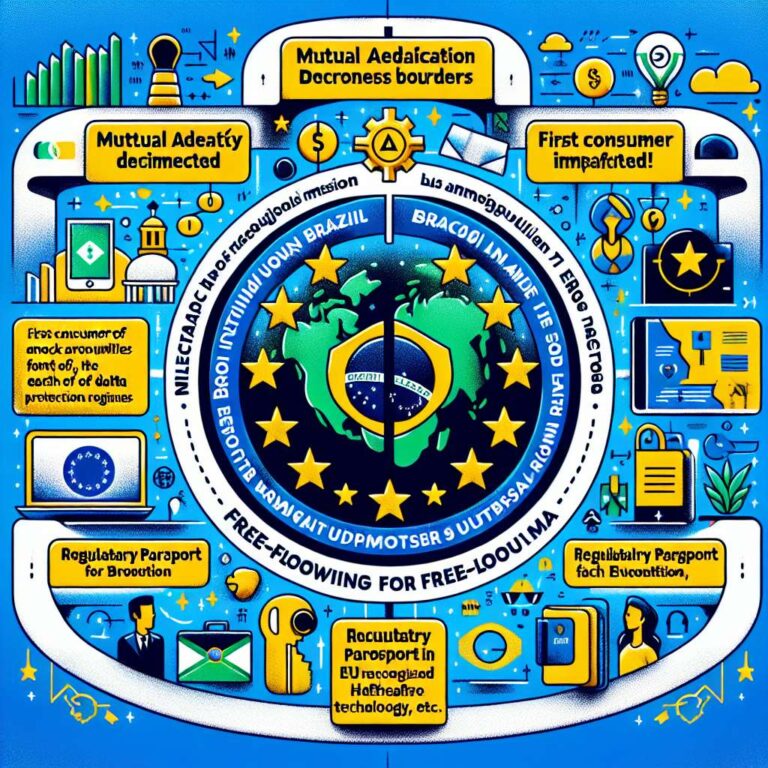
Brazil and the European Union have formally recognized each other as providing adequate protection for personal data, enabling personal data to flow between the two jurisdictions as freely as within the European single market. On January 27, 2026, with the publication of Resolution CD/ANPD No. 32/2026 and the European Commission’s adequacy decision, personal data can now be transferred between Brazil and the European Union across a combined consumer base of 670 million people. This is Brazil’s first adequacy decision and is described as the most comprehensive adequacy adopted by the European Union under the general data protection regulation, since it simultaneously covers public and private sectors and places Brazil among 17 jurisdictions recognized as adequate by the European Union.
The new framework acts as a regulatory passport for personal data, replacing the need for mechanisms such as standard contractual clauses, specific authorizations, or individualized risk assessments for most routine Brazil-European Union data flows. The Brazilian resolution takes a broad approach to scope, imposing no restrictions on categories of personal data, including sensitive data and data relating to minors, and not mandating specific technical or contractual transfer tools, as long as organizations comply with Brazil’s general personal data protection law and the general data protection regulation. The adequacy decision does not cover transfers carried out exclusively for public security, national defense, state security, or criminal investigation and prosecution, so entities operating in those areas must continue to rely on alternative legal bases and safeguards when exchanging data with European partners.
The decision is expected to bring substantial economic benefits given the scale of Brazil-European Union trade and its reliance on digital services. The commercial relationship already includes trade in goods in 2025 valued at USD 100 billion and trade in services in 2024 valued at USD 36 billion, with a digital share of services trade of 65% and corporate data flows involving personal data accounting for 45%. Studies referenced in the context of adequacy suggest an expected increase in digital trade of 7% to 9%, while Brazilian medium and high-tech manufacturing exports to the European Union total USD 10 billion and represent 43% of industrial exports to the European Union. Sectors such as agribusiness, industry 4.0, fintech, financial services, healthcare technology, and clinical research are highlighted as direct beneficiaries, with easier export of smart agricultural solutions, integrated industrial data flows, expanded digital financial services, and participation in multinational clinical trials and telemedicine.
Companies remain responsible for robust compliance and are encouraged to treat the adequacy decision as an institutional bridge rather than a blanket authorization. Recommended steps include mapping Brazil-European Union data flows, reviewing and simplifying contracts, updating privacy policies and public disclosures, training legal, compliance, and technology teams, and assessing new expansion opportunities made viable by reduced regulatory barriers. Organizations must also account for overlapping sectoral regulations that may shape how they operationalize the benefits of adequacy in practice.
Several regulatory developments could influence this new landscape in the coming years. In Brazil, a proposed artificial intelligence regulatory framework may affect companies developing or using Artificial Intelligence systems in cross-border operations, and the national data protection authority is expected to advance regulations on processing children’s data, security incident reporting, and penalty guidelines, as well as deepen sectoral cooperation with European regulators. In the European Union, the pending Mercosur-European Union agreement could amplify commercial integration, while the progressive implementation of the European Artificial Intelligence act will impose new requirements on Brazilian providers of Artificial Intelligence systems, and the European health data space regulation will add interoperability and storage obligations for health and healthcare technology firms. The adequacy decision will be subject to a four-year cycle review, with institutional cooperation between the Brazilian authority and the European Commission and the possibility of earlier reassessment if significant legal changes arise, reinforcing the link between strong data protection, innovation, and growth in digital commerce.