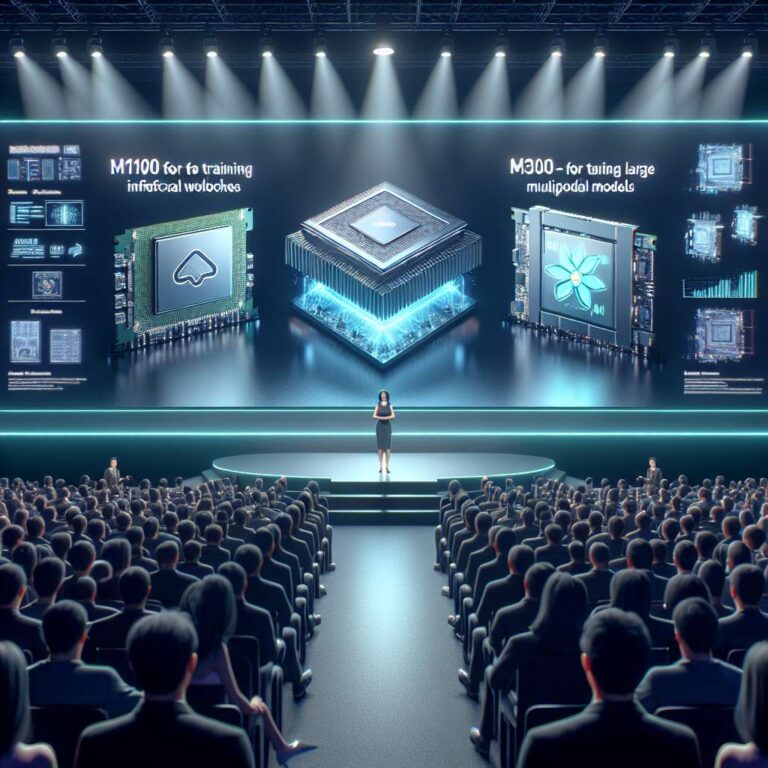
Baidu announced two new processors, the M100 and M300, at its annual Baidu World conference. Developed by its Kunlunxin Technology unit, the M100 is optimized for inference workloads and is slated to ship in early 2026, while the M300 is designed to train massive multimodal models with trillions of parameters and is expected in 2027. Baidu Cloud president Shen Dou said both chips aim to deliver “powerful, low-cost, and controllable Artificial Intelligence computing power.”
The company positioned the processors as part of a broader push to reduce reliance on foreign hardware. Baidu has been developing its own processors since 2011 and joins domestic chipmakers such as Huawei’s HiSilicon, Cambricon, MetaX, and Biren in that effort. Baidu also highlighted new large-scale cluster designs similar to Huawei’s CloudMatrix 384 system, combining hundreds of in-house processors into ‘supernode’ deployments. The Tianchi256 system will integrate 256 Baidu P800 chips and is due in the first half of 2026, with the Tianchi512, using 512 chips, planned for later in the year. Baidu said the new configuration delivers over 50 percent higher performance than its previous generation and outlined an ambition to scale these clusters to “millions” of chips by 2030.
Beyond hardware, Baidu used the event to critique the current Artificial Intelligence industry structure. Founder and CEO Robin Li described the industry as “unhealthy,” arguing that profits concentrate at the chip and foundation-model level and proposing a “reversed industry pyramid” that shifts value toward real-world applications. The company also introduced Ernie 5.0, a multimodal large language model with 2.4 trillion parameters, which Baidu said is twice the size of Alibaba’s Qwen3-Max and Moonshot’s Kimi K2. Baidu said Ernie 5.0 improves performance across text, image, video, coding, and agent tasks through unified multimodal training.