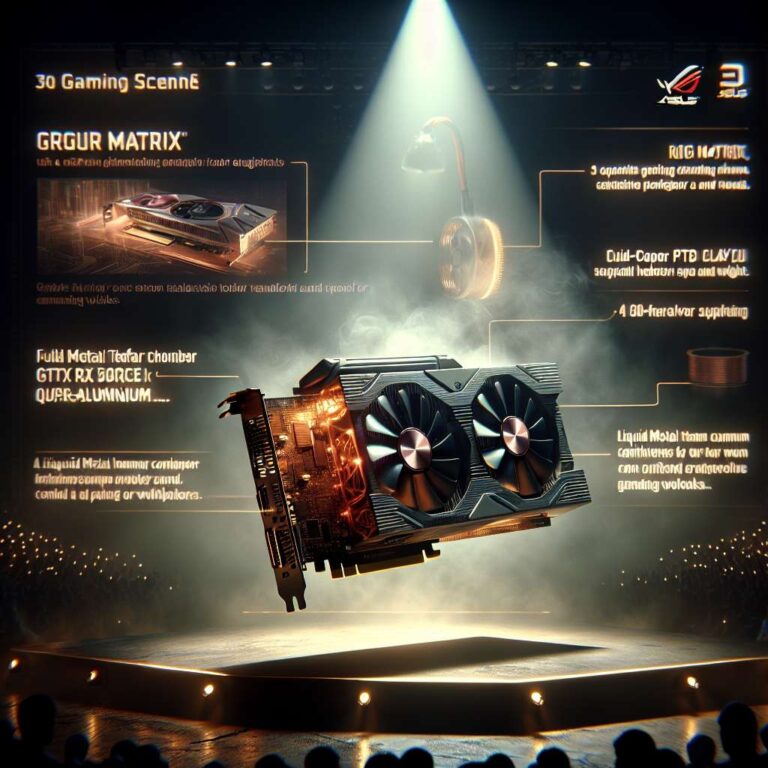
ASUS invited select media to Gamescom 2025 to present new products and mark the 30th anniversary of its first graphics card, an anniversary that closely coincides with the beginning of its partnership with NVIDIA. Jackie Hsu, senior vice president of ASUS, and John Milner, vice president of GeForce worldwide sales at NVIDIA, took the stage to introduce the ROG Matrix GeForce RTX 5090. ASUS said the new Matrix continues the family lineage by combining innovations developed over multiple generations and intentionally echoes the look of the EN9600/9800 GT Matrix, the first Matrix released by ASUS.
The ROG Matrix GeForce RTX 5090 is described as integrating a suite of cooling and build choices carried from prior Matrix cards and introducing refinements of its own. Key hardware elements called out in the presentation include a three-ounces copper PCB layer, a full-copper vapor chamber and heatpipes, and copper-aluminium fins to optimize thermal transfer. The card uses a quad-fan cooling array and employs a liquid metal thermal compound. These design choices are presented as a consolidation of ASUS´s long-running efforts to push thermal and electrical performance in its flagship cards.
The event also referenced the ROG Raikiri II controller, but the article provides no technical or availability details for the controller. Likewise, specific GPU performance metrics, clock speeds, supported power delivery or display outputs for the RTX 5090 were not stated. Availability, pricing and full specifications for the ROG Matrix GeForce RTX 5090 and the ROG Raikiri II controller are not stated in the article.