
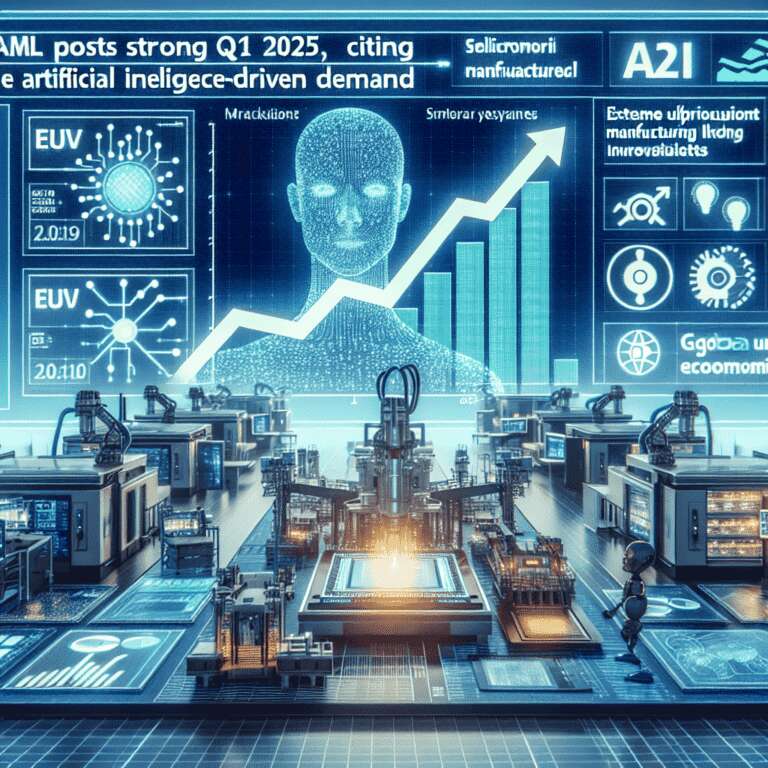
ASML Reports €7.7 Billion in Q1 2025 Sales, Sets Optimistic Outlook Amid Artificial Intelligence Growth

ASML´s first-quarter 2025 results show strong growth driven by a robust artificial intelligence market, despite macroeconomic uncertainty from new tariffs.

ASML Holding NV has announced its financial results for the first quarter of 2025, reporting total net sales of €7.7 billion, a gross margin of 54.0%, and a net income of €2.4 billion. The company´s Q1 performance came in line with prior guidance, with the gross margin notably surpassing expectations due to a favorable product mix of extreme ultraviolet (EUV) lithography equipment and successful achievement of operational milestones. Net bookings for the quarter amounted to €3.9 billion, including €1.2 billion from EUV systems, highlighting continued demand for advanced semiconductor manufacturing tools.

Looking ahead, ASML projects Q2 2025 net sales in the range of €7.2 billion to €7.7 billion and a gross margin between 50% and 53%. Despite ongoing global economic fluctuations and uncertainty following recent tariff announcements, the company maintains its full-year revenue forecast of €30 billion to €35 billion with a gross margin outlook of 51% to 53%. ASML also marked a milestone this quarter by delivering its fifth High Numerical Aperture (High NA) system, now operational at three different customer locations, reinforcing its leadership in next-generation chipmaking technologies.

ASML´s CEO emphasized that artificial intelligence continues to be the primary growth catalyst for the semiconductor equipment industry, creating both opportunities and risks as market dynamics shift among customers. The intersection of industry advancements and a volatile macroeconomic backdrop underscores the company´s cautious but optimistic outlook for 2025 and 2026, as artificial intelligence-driven demand accelerates technology adoption while introducing uncertainties related to global trade policies and customer investments.
63

Impact Score

Congress weighs Artificial Intelligence transparency rules

Bipartisan lawmakers are pushing a federal transparency standard for the largest Artificial Intelligence models as Congress works on a broader national framework. The proposal aims to increase public trust while avoiding stricter state-by-state requirements and heavier regulation.

Report finds California creative job losses are not driven by Artificial Intelligence

New research from Otis College of Art and Design finds California’s recent creative industry job losses stem from cost pressures and structural shifts, not direct worker displacement by generative Artificial Intelligence. The technology is changing workflows and expectations, but it is largely replacing tasks rather than entire jobs.

U.S. senators propose broader chip tool export ban for Chinese firms

A bipartisan proposal in the U.S. Senate would shift semiconductor equipment controls from specific fabs to targeted Chinese companies and their affiliates. The measure is aimed at cutting off access to advanced lithography and other wafer fabrication tools for firms such as Huawei, SMIC, YMTC, CXMT, and Hua Hong.

Trump executive order targets state Artificial Intelligence laws

Executive Order 14365 lays out a federal strategy to discourage, challenge, and potentially preempt state Artificial Intelligence laws viewed as burdensome. Employers are advised to keep complying with current state and local rules while preparing for regulatory uncertainty in 2026.

Who decides how America uses Artificial Intelligence in war

Stanford experts are divided over how the United States should govern Artificial Intelligence in defense, surveillance, and warfare. Their views converge on one point: decisions with such high stakes cannot be left to companies alone.

Contact Us

Got questions? Use the form to contact us.

Contact Form

Clicking next sends a verification code to your email. After verifying, you can enter your message.