
Artificial Intelligence infrastructure boosts enterprise SSD demand as top vendors post 16.5% QoQ growth

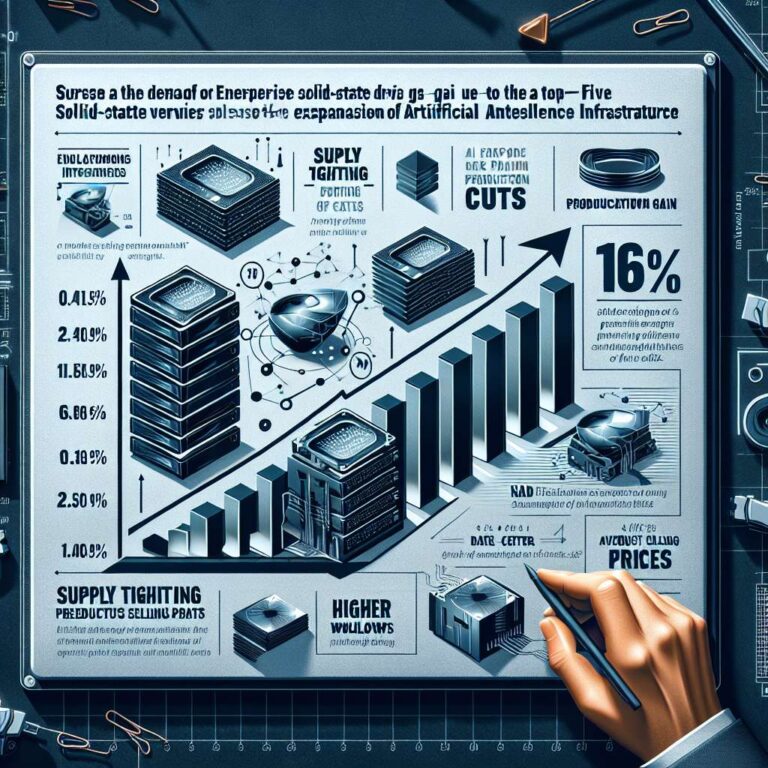
TrendForce reports that the expansion of Artificial Intelligence infrastructure by CSPs drove strong enterprise SSD demand in 3Q25, lifting the combined revenue of the top five NAND Flash vendors by 16.5% QoQ. TrendForce also forecasts continued demand for high-performance enterprise SSDs into 4Q25 amid rising NAND Flash prices.

TrendForce research shows that the ongoing expansion of Artificial Intelligence infrastructure by CSPs fueled strong demand for enterprise SSDs in 3Q25. The report states the combined revenue of the top five NAND Flash vendors grew by 16.5% QoQ, approaching US$17.1 billion. Earlier production cuts are starting to affect the market, helping to balance supply and demand in the latter half of the year, while a rising proportion of enterprise SSD shipments contributed to increased ASPs among suppliers.

Looking ahead to 4Q25, TrendForce forecasts that demand driven by Artificial Intelligence for high-performance TLC and QLC enterprise SSDs will continue to grow. The research cautions that as suppliers’ inventories normalize and node migrations generate typical yield-related losses, shipment growth will be more restrained. At the same time, ongoing shortages in HDD supply are expected to maintain upward pressure on NAND Flash prices, with TrendForce predicting total NAND Flash prices will rise by 20–25%, which would further boost quarterly revenue for vendors.

The analysis frames the current market as one of tightening supply and sustained demand for enterprise-class storage. Production cuts and inventory normalization are rebalancing supply and demand, while technology transitions and yield impacts may limit shipment growth despite strong orders for high-performance SSDs. Price increases driven in part by HDD shortages and a higher share of enterprise SSDs in shipments point to improved ASPs and revenue upside for NAND Flash suppliers in the near term.
55

Impact Score

Artificial intelligence becomes a lever for transformation in Africa

African researchers and institutions are positioning artificial intelligence as a tool to tackle structural challenges in health, education, agriculture and governance, while pushing for data sovereignty and local language inclusion. The continent faces hurdles around skills, infrastructure and control of data but is exploring frugal technological models tailored to its realities.

Microsoft unveils Maia 200 artificial intelligence inference accelerator

Microsoft has introduced Maia 200, a custom artificial intelligence inference accelerator built on a 3 nm process and designed to improve the economics of token generation for large models, including GPT-5.2. The chip targets higher performance per dollar for services like Microsoft Foundry and Microsoft 365 Copilot while supporting synthetic data pipelines for next generation models.

Samsung’s 2 nm node progress could revive foundry business and attract Qualcomm

Samsung Foundry’s 2 nm SF2 process is reportedly stabilizing at around 50% yields, positioning the Exynos 2600 as a key proof of concept and potentially helping the chip division return to profit. New demand from Tesla Artificial Intelligence chips and possible deals with Qualcomm and AMD are seen as central to the turnaround.

Contact Us

Got questions? Use the form to contact us.

Contact Form

Clicking next sends a verification code to your email. After verifying, you can enter your message.